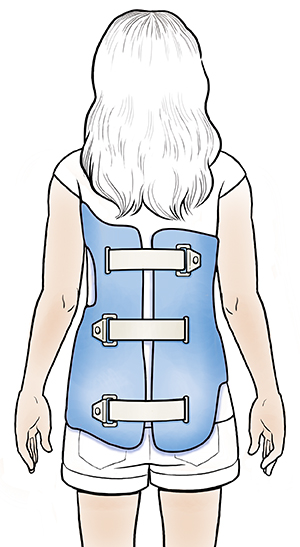
A brace helps stop the scoliosis curve in your spine from getting worse as you grow. It may also help keep you from needing surgery. To do the job, the brace needs to be worn almost all the time until you are fully grown.
Fitting the brace
An orthotist is the person who makes and fits the brace to your body. Before the brace fits you right, you will most likely go to the orthotist a few times to have it adjusted.
Tips for wearing a brace
Here are some suggestions:
-
Wear only a soft, clean T-shirt under your brace to protect your skin. Choose a shirt that fits tight so there are few wrinkles. Change the T-shirt every day and when it gets dirty or sweaty.
-
Keep your skin clean and dry. Shower daily.
-
Don’t hide the brace from your friends. Tell them what it is and why you have to wear it. You will most likely find that your friends will be great support.
-
Ask your orthotist about the best way to clean your brace.
-
See your healthcare provider as often as instructed so they can check how well the brace is working for you.
Keeping active
Your healthcare provider may ask you to do some exercises to help keep your back flexible and make it stronger. Do them as often as you're instructed. Stay active by walking and doing other activities. You can still play sports if you want to. You can take your brace off for certain sports, such as swimming and running. Your healthcare provider can tell you more about this.
When to call your healthcare provider
Contact your healthcare provider if:
-
You gain more than 10 pounds
-
The brace starts fitting differently
-
The brace hurts you or rubs your skin, causing redness or a rash
-
Something keeps you from wanting to wear your brace
Online Medical Reviewer: L Renee Watson MSN RN
Online Medical Reviewer: Raymond Turley Jr PA-C
Online Medical Reviewer: Thomas N Joseph MD
Date Last Reviewed: 04/01/2024
© 2000-2025 The StayWell Company, LLC. All rights reserved. This information is not intended as a substitute for professional medical care. Always follow your healthcare professional's instructions.
Find the right provider to meet your needs
From primary care to specialty services and more.
Find a Doctor
Call for an Appointment
Offering personalized care at more than 20 clinics across three cities and two states.
Call NowRelated Articles
Discharge Instructions for Open Rotator Cuff Repair
If you've had rotator cuff repair, this sheet can help you care for yourself after the procedure.
Cast Care: When Your Cast Comes Off
Just because your cast is off, it doesn't mean that your recovery is over. Your bone is still growing stronger and you need to care for your injury.
What to Expect: The Months After Amputation Surgery
Here's what to expect in the months after amputation surgery.
After Knee Arthroscopy
Learn what to expect after knee arthroscopy.