Chronic means ongoing. Pain is called chronic when it lasts over a long period of time—at least 3 months. This includes pain that you feel regularly, even if it comes and goes. Chronic pain may be due to continuing injury or disease. Or it may be due to problems with the body’s pain-control system. An example of this is fibromyalgia.
Chronic stimulus
Chronic pain may be from ongoing arousal of the body's pain system. The cause may be an untreated injury or health problem. Common examples of these are:
-
Joint degeneration (arthritis).
-
Back injury.
-
Nervous system damage (neuropathic pain).
-
Headaches.
With this type of pain, both the pain and the condition that is causing it must be treated.
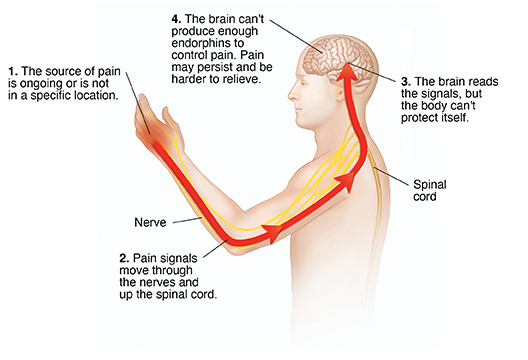
Chronic pain syndrome
In some cases, no cause can be found for a person's chronic pain. Some people with chronic pain develop chronic pain syndrome. In addition to the pain, this can include:
-
Anxiety.
-
Depression.
-
Anger.
-
Changed lifestyle.
It's important to talk with your health care team about these. You will need treatment for these problems in addition to treatment for pain.
Featured in
Online Medical Reviewer: Jimmy Moe MD
Online Medical Reviewer: Kenny Turley PA-C
Online Medical Reviewer: Maryann Foley RN BSN
Date Last Reviewed: 02/01/2025
© 2000-2025 The StayWell Company, LLC. All rights reserved. This information is not intended as a substitute for professional medical care. Always follow your healthcare professional's instructions.
Find the right provider to meet your needs
From primary care to specialty services and more.
Find a Doctor
Call for an Appointment
Offering personalized care at more than 20 clinics across three cities and two states.
Call NowRelated Articles
Managing Chronic Pain: Therapies for Mind and Body
Both the brain and the body are involved in the pain response. The brain "reads" the pain signals from the body. This means that your mind has some control over how pain signals are processed. Mind-body therapies may help change how your brain "reads" pain signals.
Understanding an Intrathecal Pain Pump Implant
An intrathecal pain pump implant is a way to relieve some kinds of long-term pain or cancer pain. It sends pain medicine through a thin, flexible tube. The tube is inserted into the space around the spinal cord.
Managing Chronic Pain: Medicines
Medicines can help you live better with chronic pain. You may use over-the-counter or prescription medicines. It can take some time and trial and error to work out the best treatment plan for you.
Managing Chronic Pain with Over-the-Counter Medications
Over-the-counter medications can help manage chronic pain, but overuse can lead to some major health problems.