You can help prevent illness and injury by reading the warning label for each hazardous substance you use. If you have any questions after reading the warning label, check the SDS. The SDS is a detailed source of information for the hazardous substance you are using. The image is an example of a National Fire Protection Association (NFPA) label you might find on a container.
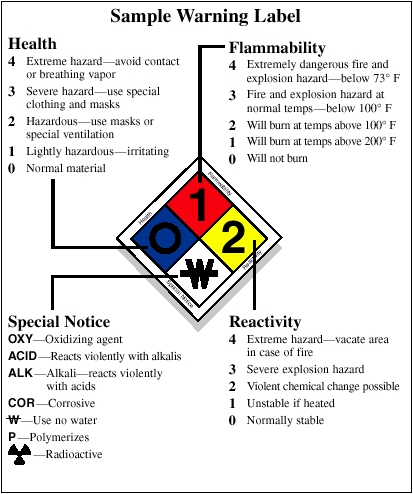
NFPA 704 warning labels
You may see a warning label on a container or box of containers, such as a case of chemical jugs. These labels provide the most important information you need to know about the substance you are handling.
The number system is based on the NFPA 704 rating:
-
Hazard ratings range from 0 to 4, with 4 being the most hazardous. These are used for three categories: health (blue), flammability (red), and instability (yellow). For example, if the substance has a low risk for flammability, a “1” may appear in the flammability section.
-
The Special Hazard category shows other important hazards to be aware of. These include OX (oxidizers), W (water reactives), and SA (simple asphyxiant gases, such as nitrogen or helium).
Online Medical Reviewer: Eric Perez MD
Online Medical Reviewer: Marianne Fraser MSN RN
Online Medical Reviewer: Raymond Kent Turley BSN MSN RN
Date Last Reviewed: 12/01/2022
© 2000-2025 The StayWell Company, LLC. All rights reserved. This information is not intended as a substitute for professional medical care. Always follow your healthcare professional's instructions.
Find the right provider to meet your needs
From primary care to specialty services and more.
Find a Doctor
Call for an Appointment
Offering personalized care at more than 20 clinics across three cities and two states.
Call NowRelated Articles
Ergonomics: Lighting Your Work Area
Glare is the reflection off your screen that makes it hard to see the screen clearly. Glare can be caused by sunlight on your screen. Or it may be caused by indoor light, such as overhead and task lamps. Simple changes can help reduce glare and strain on your eyes. Adjusting your screen's contrast and brightness can also improve viewing comfort.
Do You Have a Family Disaster Plan?
Natural disasters can strike quickly and force families like yours to evacuate your neighborhood. But families can and do survive such circumstances if they prepare in advance. These suggestions can help you plan for the worst.
Preventing Falls: In the Hospital
At some point, you may need care in a hospital or other facility. People may ask how well you can move around. Answer this question honestly. If you have a high risk of falling, the staff will take extra steps to help keep you safe. Here are some tips to keep you safe in the hospital.
Exercises at Your Workstation: Eyes, Neck, and Head
Tired eyes? Stiff neck? A few easy moves can help prevent these kinds of problems.