If you sit much of the day, your chair is your main support. A well-adjusted chair improves your circulation. It also helps prevent backaches and fatigue. You can increase your comfort by adjusting the chair's backrest position and height to fit your body.
Backrest
-
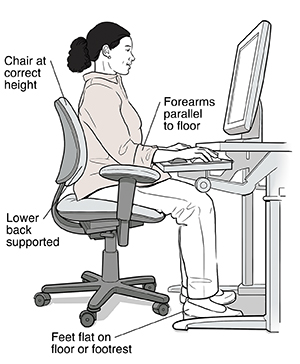
Sit at your workstation, leaning back slightly with your back firmly against the chair and the shoulders touching the backrest. The backrest should fit snugly against your lower back.
-
If it doesn't , adjust the backrest until your lower back is fully supported. Adjust the height of the backrest to support the natural inward curvature of the lower back.
-
If you can't adjust the backrest , use a small, thin, firm pillow or rolled-up towel or lumbar pad to support your lower back.
-
The backrest angle should be set so that your hip-torso angle is 90 ° or greater.
-
Use a chair with a backrest that is easily adjustable and able to support the back in a variety of seated postures.
Chair height
Arm position
-
Place your fingers on the keyboard's middle row of letters. Your upper arms should hang comfortably at your sides, and your shoulders should be relaxed while keyboarding. Your forearms should be parallel to the floor.
-
If they are not , adjust your chair height until your forearms are parallel to the floor.
-
When armrests are used, elbows and lower arms should rest lightly so as not to cause circulatory or nerve problems.
-
Position adjustable armrests so they support your lower arm and allow your upper arm to remain close to the torso. Don't use the armrests to slouch.
-
Armrests should be made of a soft material and have rounded edges.
Leg position
-
Keep your knees at or below the level of your hips. It may help to slide your feet forward until your knees are at a 90 to 110 degree angle. Your feet should rest firmly on the floor. There should be 1 to 2 inches of legroom between your lap and desk or keyboard tray.
-
If you have less than 2 inches of legroom, try to raise your desk or keyboard tray height.
-
If you can't adjust your chair height and your feet don't reach the floor, use something as a footrest. A box or binder can work. If you wear flat shoes, a level surface works best. If you wear heels, a slanted surface is better.
-
The back of your knees should not come in direct contact with the edge of the seat pan (there should be 2 to 3 inches between the edge of the seat and the back of the knee).
-
Your thighs should be parallel to the floor and your knees at about the same level as your hips.
Online Medical Reviewer: Chris Southard RN
Online Medical Reviewer: Marianne Fraser MSN RN
Online Medical Reviewer: Vinita Wadhawan Researcher
Date Last Reviewed: 10/01/2024
© 2000-2025 The StayWell Company, LLC. All rights reserved. This information is not intended as a substitute for professional medical care. Always follow your healthcare professional's instructions.
Find the right provider to meet your needs
From primary care to specialty services and more.
Find a Doctor
Call for an Appointment
Offering personalized care at more than 20 clinics across three cities and two states.
Call NowRelated Articles
Domestic Abuse: Changing Your Life
Abuse tends to get worse and occur more often over time. If you are being abused, plan ahead to get out for good. But don't feel discouraged if it takes more than one try.
Sexual Harassment in the Workplace
Unwelcome behavior of a sexual nature is known as sexual harassment. This type of harassment may create unpleasant working conditions or make sexual favors the basis for employment. Learn how to recognize this behavior and what to do if it happens to you.
Walkers: Bathing
Follow these instructions for safely getting in and out of the bathtub or shower when you use a walker.
Preventing Physical Assault
The following tips describe how to reduce your chances of being physically assaulted.