An armpit (axillary) temperature is taken by holding the thermometer under your baby's arm. To give a correct reading, this must be done with care. Armpit temperatures are a good screening for a child of any age. But they're not the most accurate way to take your child's temperature. Use the steps on this handout as a guide.
Getting the thermometer ready
-
Be sure to use a thermometer that's for armpit use.
-
Clean the thermometer before and after each use.
-
Make sure the thermometer is at room temperature.
-
Remove the cover from the thermometer.
Positioning your baby
-
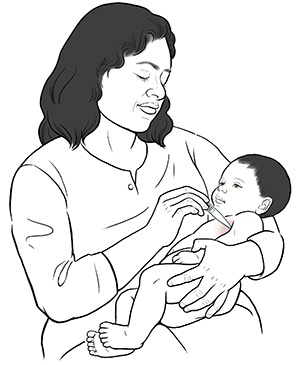
Hold your baby on your lap. Or lay your infant on their back on a firm surface.
-
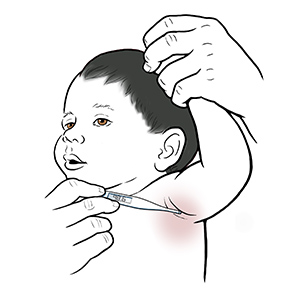
Grasp your baby's elbow. Gently but firmly lift the arm away from baby's side.
-
Place the tip of the thermometer in the fold of the armpit. To get a true reading, make sure the thermometer is against your baby's skin on all sides.
-
Bring the arm down next to the baby's side.
Taking the temperature
Follow the instructions for using your digital thermometer.
-
Keep your baby's arm against their side. This keeps the thermometer in place.
-
When the thermometer beeps, release your hold and gently lift your baby's arm. Remove the thermometer.
-
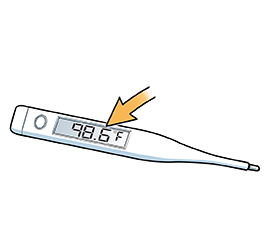
Read the temperature on the digital display. Normal temperature is around 98.6°F (37°C). But it can range from 97.6°F to 99.6°F (36.4°C to 37.6°C). Armpit temperatures can range from 0.5°F to 1°F (0.3°C to 0.6°C) lower than a rectal temperature.
-
Before putting the thermometer away, clean it with soap and warm water or alcohol.
-
When reporting the temperature to your baby's healthcare provider, tell them that it was an axillary temperature reading.
Online Medical Reviewer: Amy Finke RN BSN
Online Medical Reviewer: Heather M Trevino BSN RNC
Online Medical Reviewer: Liora C Adler MD
Date Last Reviewed: 06/01/2022
© 2000-2025 The StayWell Company, LLC. All rights reserved. This information is not intended as a substitute for professional medical care. Always follow your healthcare professional's instructions.
Find the right provider to meet your needs
From primary care to specialty services and more.
Find a Doctor
Call for an Appointment
Offering personalized care at more than 20 clinics across three cities and two states.
Call NowRelated Articles
Why Children Get Carsick—And What to Do
A look at why kids get carsick, with helpful tips for prevention—and what to do if it occurs.
Screen Time and Children
Many children watch too much digital media, which includes TV, the internet, and smart devices. Learn why too much screen time is not good for kids--and how to set limits and establish good viewing habits.
Moving Your Toddler from Crib to Bed
Moving your child from the crib to a first bed is a milestone event. But more than the bittersweet emotional concerns, your priorities will be safety and a healthy sleep routine.
Stuttering in Children
Stuttering is a speech problem. The normal flow of speech is disrupted. A child who stutters repeats or prolongs sounds, syllables, or words. Stuttering is different from repeating words when learning to speak. Stuttering may make it difficult for a child to communicate with others.