Ureteroscopic stone removal may be done before, after, or instead of other treatments. If you need this procedure, your doctor will discuss its risks and possible complications. Talk with your doctor about your medical conditions, allergies, and any medicines you take. This includes medicines that don't need a prescription, vitamins, and supplements. You will get instructions on how to prepare. You will also be given information about the type of anesthesia you will have. This will keep you pain-free during treatment.
Removing the stone through the ureter
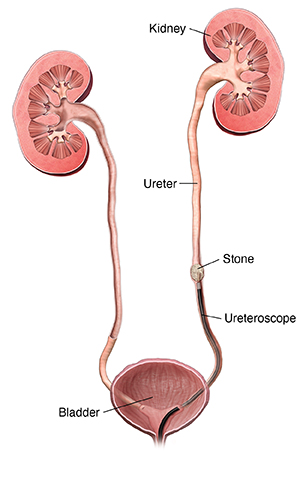
Ureteroscopic stone removal extracts a small stone in your ureter. This is done without an incision. The ureter is the tube that urine flows through from the kidney to the bladder. Your doctor places a viewing tube (ureteroscope) in your ureter. A wire basket inserted through the tube removes the stone. Sometimes, a laser or a mechanical device is used to break up a larger stone. A soft tube may be left in your ureter briefly to drain urine.
Your recovery
This is an outpatient or overnight procedure. For a few days after surgery, you may feel some pain when you urinate. You may also feel the need to urinate more often or have bloody urine.
You may be given medicines to relieve pain. You may also use ice packs or heating pads to relieve pain.
You may be given an antibiotic for 1 or 2 days to prevent an infection. If your doctor prescribed antibiotics, take them as directed. You need to take the full course of antibiotics.
You may be instructed to drink at least 8 to 16 ounces of water per hour for a few hours after the procedure.
You may have a ureteral stent. This is a soft tube that prevents swelling and blockage after the procedure. The stent is removed when the swelling goes down, often within days. Follow up as instructed to check for any new stones.
When to contact your doctor
Contact your doctor right away if:
-
You have sudden pain or flank pain.
-
You have a fever over 100.4°F (38°C), or as advised by your doctor.
-
You have nausea that lasts longer than suggested in your discharge instructions.
-
You have heavy bleeding when you urinate.
-
You have heavy bleeding through your drainage tube.
-
You have swelling or redness around your incision.
Online Medical Reviewer: Raymond Kent Turley BSN MSN RN
Online Medical Reviewer: Rita Sather RN
Online Medical Reviewer: Walead Latif MD
Date Last Reviewed: 04/01/2025
© 2000-2025 The StayWell Company, LLC. All rights reserved. This information is not intended as a substitute for professional medical care. Always follow your healthcare professional's instructions.
Personalized Pediatric Care
San Juan Health Partners Pediatrics. Dedicated to caring for your children.
Find a Doctor
Personalized Services Just for You
San Juan Health Partners Urology. Compassionate care you can trust.
Find a Doctor
Call for an Appointment
Offering personalized care at more than 20 clinics across three cities and two states.
Call NowRelated Articles
Treating Kidney Stones: Medicines
In some cases, your doctor may prescribe medications to dissolve or prevent stones. Or medications may be prescribed to stop an infection. Once the infection is controlled, your stone can be removed.
Having a Ureteral Stent
A ureteral stent is temporarily inserted into a ureter to help drain urine into the bladder. Learn about the procedure and what to expect while you have a stent.
Treatment Options for Kidney Failure
If the kidneys fail, blood is no longer filtered. Though kidney failure has no cure, certain treatments can help keep the body working the best it can.
Treating Kidney Stones: Percutaneous Nephrolithotomy
Percutaneous nephrolithotomy may be done before, after, or instead of other treatments. If you need this procedure, your doctor will discuss its risks and possible complications.