Postural drainage is a way to change your body position to help your lungs drain. If you have a long-term (chronic) lung problem associated with excessive mucus, or you have increased mucus from an infection, lying with your chest lower than your belly (abdomen) can help loosen and drain extra mucus from your lungs. The guidelines below will help you know what to do.
General guidelines
-
Check with your healthcare provider before trying this therapy.
-
Find positions that are comfortable for you. You can lie on a bed or on the floor, using pillows. Try some of the positions that are described below.
-
Stay in each position for at least 5 minutes.
-
When you feel the urge to cough, sit up and do controlled coughing.
-
Make sure to do postural drainage before meals or at least 90 minutes after eating. This helps prevent vomiting.
-
If your healthcare provider prescribed medicines such as a bronchodilator or inhaler, ask how long to wait to do postural drainage after using the medicine.
-
Sometimes postural drainage is used along with other therapies such as chest percussion, vibration, or use of a flutter valve. Talk with your healthcare provider before you combine different treatments together.
When not to do postural drainage
Always talk with your healthcare provider before starting postural drainage. Don't try this therapy if you:
-
Have mild pain when you are in certain physical positions
-
Are coughing up blood
-
Have rib fractures
-
Are using blood-thinning medicines
-
Have vertebral fractures or osteoporosis
On your back
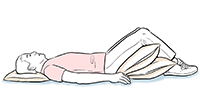
Try this position to drain the front of your lungs.
-
Lie on a slanted surface with your chest lower than your hips.
-
Place a small pillow under your head. Put 2 pillows under your bent knees.
-
Rest your arms at your sides and breathe in through your nose and out through your mouth. Remember: Always breathe out for longer than you breathe in. This allows your lungs to empty as much as possible.
On each side
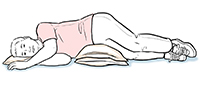
Try this position to drain the sides of your lungs.
-
Place a small pillow under your head and 2 or 3 pillows under your hips.
-
Lie on one side with your chest lower than your hips.
-
Breathe in through your nose. Breathe out through your mouth.
-
After 5 to 10 minutes, switch to the other side.
On your stomach
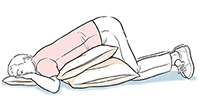
Try this position to drain the back of your lungs.
-
Put 2 or 3 pillows under your stomach.
-
Drape your body over the pillows so that your chest is lower than your hips.
-
Rest your arms by your head.
-
Breathe in through your nose. Breathe out through your mouth.
Follow-up care
Make a follow-up appointment as directed.
When to call your healthcare provider
Call your healthcare provider right away if you have any of the following:
-
Wheezing or constant coughing
-
Symptoms get worse, or you have new symptoms
-
Increased mucus
-
Yellow, green, brown, bloody, or smelly mucus
-
Fever of 100.4°F (38°C) or higher, or as directed by your provider
-
Fast or irregular heartbeat
-
Swollen ankles
-
Pain
Call 911
Call
-
Trouble breathing
-
Confusion or trouble staying awake
-
Loss of consciousness or fainting
-
Chest pain or tightness
-
Skin is a blue color
-
Coughing up blood
-
Severe pain
Online Medical Reviewer: Andrew D Schriber MD
Online Medical Reviewer: Jessica Gotwals RN BSN MPH
Online Medical Reviewer: Rita Sather RN
Date Last Reviewed: 12/01/2022
© 2000-2025 The StayWell Company, LLC. All rights reserved. This information is not intended as a substitute for professional medical care. Always follow your healthcare professional's instructions.
Expert Surgical Care
San Juan Health Partners General Surgery. Providing personalized treatment options for you.
Learn More
Call for an Appointment
Offering personalized care at more than 20 clinics across three cities and two states.
Call NowRelated Articles
Incision Care
No matter how your incision was closed, follow these tips to help your incision heal once you get home.
Wound Check After Surgery: Infection
Infection after surgery often affects just the top layers of skin. Sometimes the infection is deeper in the wound and may include a collection of fluid or pus. Treatment will depend on the type of infection you have.
After Laparoscopic Splenectomy
You have had surgery to remove your spleen (splenectomy). This sheet will help you take care of yourself at home.
Staple Removal (No Complication)
Your wound is healing as expected. It has healed well enough that the staples were removed. At this time there is no sign of a wound infection.