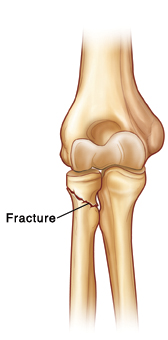
You have a break (fracture) of 1 or more bones of your elbow joint. This may be a small crack in the bone. Or it may be a major break, with the broken parts pushed out of position.
This fracture usually takes 4 to 12 weeks to heal, depending on the type. The first step in treatment is to have a splint or cast. Severe fractures may need surgery to put the bone fragments back into place. This is done by an orthopedic surgeon. This is a surgeon who specializes in treating bone, muscle, joint, and tendon problems.
Home care
Follow these guidelines when caring for yourself at home:
-
Keep your arm raised (elevated) to reduce pain and swelling. When sitting or lying down, keep your arm above the level of your heart. You can do this by placing your arm on a pillow that rests on your chest or on a pillow at your side. This is most important during the first 2 days (48 hours) after the injury.
-
Put an ice pack on the injured area. Do this for 20 minutes every 1 to 2 hours the first day. To make an ice pack, place ice cubes in a plastic bag that seals at the top. Wrap the bag in a thin towel. As the ice melts, be careful that the cast or splint doesn’t get wet. You can place the ice pack inside the sling and directly over the splint or cast. Keep using the ice pack 3 to 4 times a day for the next 2 days. Then use the ice pack as needed to ease pain and swelling.
-
Keep the splint or cast completely dry at all times. Bathe with your splint or cast out of the water. Protect it with a large plastic bag, rubber-banded or taped at the top end. If a fiberglass splint or cast gets wet, you can dry it with a hair dryer on a cool setting.
-
You may use acetaminophen or ibuprofen to control pain unless another pain medicine was prescribed. If you have chronic liver or kidney disease, talk with your health care provider before using these medicines. Also talk with your provider if you’ve had a stomach ulcer, gastrointestinal bleeding, or take a blood thinner.
-
Don’t put creams or objects under the cast if you have itching.
Follow-up care
Follow up with your provider as advised. That's to make sure the bone is healing the way it should. If a splint was put on, it may be changed to a cast during your follow-up visit.
X-rays may be taken. You'll be told of any new findings that may affect your care.
When to contact your doctor
Contact your provider right away if:
-
The cast or splint cracks.
-
The plaster cast or splint becomes wet or soft.
-
The fiberglass cast or splint stays wet for more than 24 hours.
-
You feel tightness or pain under the cast or splint gets worse.
-
A bad odor comes from the cast or wound fluid stains the cast.
-
Your fingers become swollen, cold, blue, numb, or tingly.
-
You can’t move your fingers.
-
The skin around cast becomes red.
-
You have a fever of 100.4ºF (38ºC) or higher as advised by your provider.
-
You have chills.
Online Medical Reviewer: Kenny Turley PA-C
Online Medical Reviewer: L Renee Watson MSN RN
Online Medical Reviewer: Thomas N Joseph MD
Date Last Reviewed: 02/01/2025
© 2000-2025 The StayWell Company, LLC. All rights reserved. This information is not intended as a substitute for professional medical care. Always follow your healthcare professional's instructions.
Find the right provider to meet your needs
From primary care to specialty services and more.
Find a Doctor
Call for an Appointment
Offering personalized care at more than 20 clinics across three cities and two states.
Call NowRelated Articles
Leg Cramps
A muscle cramp or spasm is a strong contraction of the muscle fibers.
Back Sprain or Strain
Learn how to care for your back sprain or strain at home.
Rib Fracture
You broke 1 or more ribs. This is called a rib fracture.
Wrist Splint
A splint is designed to prevent movement of the bones, muscles and tendons. Quick-release wrist splints are used because of their comfort and convenience for wrist and hand injuries.