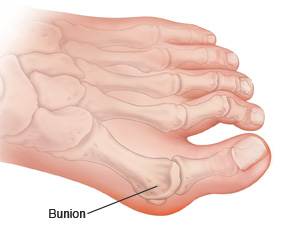
You have a bunion. This is a bony bump at the base of your big toe, along the inside edge of your foot. As the bump gets bigger, it can become red, swollen, and painful with shoe wear.
Bunions may occur if you wear shoes that are too tight and pinch your toes together. High heels may make this worse. In some cases, a bunion is due to poor alignment of the foot and ankle. This puts extra weight on the instep of each foot.
Once a bunion forms, it changes the way weight is spread all across your foot. This causes the bunion to get worse over time. The big toe will bend more and more toward the other toes.
A minor bunion can be treated by:
-
Wearing correctly fitting shoes.
-
Using bunion pads or a toe spacer.
-
Wearing shoe inserts, called orthotics, to better align the foot and ankle.
Physical therapy with ultrasound or whirlpool baths can ease pain, redness, and swelling. Severe cases may need surgery. If you don’t treat what is causing the bunion, it may get larger and more painful.
Home care
-
Don't wear high heels. These shoes force your foot forward, crowding the toes together.
-
Wear comfortable shoes with a wide toe area. Or have your existing shoes stretched by a shoe repair shop.
-
Don't wear shoes that are tight, narrow, or pointed.
-
If you are flat-footed, using arch supports may help prevent further deformity. The best shoe inserts are the ones custom made by an orthotic professional, an orthotist, or other health care provider.
-
Put a bunion pad over the bunion to ease pressure of your shoe against the bunion. You can buy these pads at most pharmacies without a prescription.
-
To reduce pain and swelling, apply an ice pack over the injured area for 15 to 20 minutes. Do this every 1 to 2 hours the first day. Keep using ice 3 to 4 times a day until the pain and swelling goes away.
-
To make an ice pack, put ice cubes in a sealed zip-lock plastic bag. Wrap the bag in a clean, thin towel or cloth. Never put ice or an ice pack directly on the skin. Check your skin often for sensation while using cold therapy. This will help make sure you aren't damaging the tissues.
-
You may use over-the-counter pain medicine to control pain, unless another medicine was prescribed. Talk with your provider before using these medicines if you have chronic liver or kidney disease, you ever had a stomach ulcer or gastrointestinal bleeding, or you use a blood thinner.
Follow-up care
Follow up with a health care provider as advised.
If X-rays were taken, you will be notified of any new findings that may affect your care.
When to get medical care
Contact your provider if you have:
-
Increasing pain or redness around the base of the big toe.
-
A painful ingrown toenail, with redness and swelling or pus around the nail.
Online Medical Reviewer: Rahul Banerjee MD
Online Medical Reviewer: Raymond Turley Jr PA-C
Online Medical Reviewer: Stacey Wojcik MBA BSN RN
Date Last Reviewed: 03/01/2025
© 2000-2025 The StayWell Company, LLC. All rights reserved. This information is not intended as a substitute for professional medical care. Always follow your healthcare professional's instructions.
Find the right provider to meet your needs
From primary care to specialty services and more.
Find a Doctor
Call for an Appointment
Offering personalized care at more than 20 clinics across three cities and two states.
Call NowRelated Articles
Sacroiliitis
Sacroiliitis is when one or both sacroiliac joints are hurt or inflamed. It can make small movements of the lower back and pelvis very painful. Learn how to care for yourself at home.
Understanding a Clavicle Fracture
A fracture of the clavicle is a broken collarbone. Clavicle fractures occur most often along the middle of the bone. Depending on how badly the bone is broken, healing may take a few months or longer.
Thoracic Spine Strain
Learn how to care for a thoracic spine strain.
De Quervain Tenosynovitis
De Quervain tenosynovitis is inflammation of tendons and synovium on the thumb side of the wrist. Learn how to care for this condition at home.