Open reduction and internal fixation (ORIF) puts the pieces of a broken bone back together so they can heal. Open reduction means the bones are put back in place during a surgery through a cut (incision). Internal fixation means that special hardware is used to hold the bone pieces together. This helps the bone heal correctly. The procedure is done by an orthopedic surgeon. This is a doctor with special training in treating bone, joint, and muscle problems.
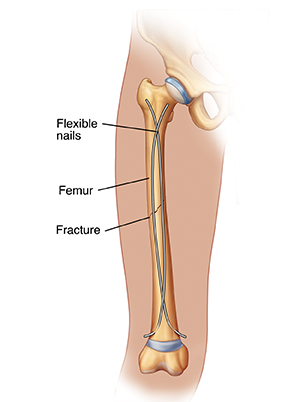
How does a femur fracture happen?
The femur is the long, thick bone in the upper part of your leg (thigh). Different kinds of injury, such as a car accident, sports injury, or fall, can cause the femur to break (fracture) into two or more pieces. In some cases, the bone may break but the pieces are still lined up correctly. Or, the pieces may not line up correctly. This is called a displaced fracture.
Why is femur fracture ORIF done?
This type of injury needs ORIF to repair. Without ORIF, your broken femur may not heal normally. You are likely to need ORIF if:
-
You have a displaced fracture.
-
Part of your femur broke through the skin.
-
Your femur broke into several pieces.
How is a femur fracture ORIF done?
The surgery is done by an orthopedic surgeon. The surgery can be done in several ways. The surgeon will make a cut (incision) through the skin and muscles of your thigh. The surgeon puts the pieces of your femur back in place. This is the reduction. Then special screws, plates, wires, or pins are used to hold the bone pieces together. This is the fixation. A special metal rod may be put through the middle of the bone if you have a fracture in the middle of your femur. The rod screws into the bone at both ends.
What are the risks of femur fracture ORIF?
All surgery has risks. The risks of femur fracture ORIF include:
-
Infection.
-
Bleeding.
-
Nerve damage.
-
Bone healing out of line.
-
Blood clots.
-
Fat tissue passing into the bloodstream and blocks a blood vessel (fat embolism).
-
Skin irritation from the hardware.
-
Problems from anesthesia.
-
Need for more surgery.
Your risks vary based on your age and general health. For example, if you are a smoker or if your bones are weak (low bone density), you may have a higher risk of certain problems. People with poorly controlled diabetes may also have a higher risk of problems. Talk with your health care provider about which risks apply most to you.
Online Medical Reviewer: Raymond Turley Jr PA-C
Online Medical Reviewer: Stacey Wojcik MBA BSN RN
Online Medical Reviewer: Thomas N Joseph MD
Date Last Reviewed: 02/01/2025
© 2000-2025 The StayWell Company, LLC. All rights reserved. This information is not intended as a substitute for professional medical care. Always follow your healthcare professional's instructions.
Find the right provider to meet your needs
From primary care to specialty services and more.
Find a Doctor
Call for an Appointment
Offering personalized care at more than 20 clinics across three cities and two states.
Call NowRelated Articles
Treatment for Baker Cyst (Popliteal Cyst)
A Baker cyst (popliteal cyst) is a fluid-filled sac that forms behind the knee. Here are possible treatments and complications.
Laminectomy
Laminectomy is a surgery that removes the part of the vertebra called the lamina. Here's a look at what you can expect before, during, and after the procedure.
Treating Mallet, Hammer, and Claw Toes
Learn how these common conditions affecting the toes are treated.
Elbow Arthroscopy: Conditions Treated
Arthroscopy is used to find and treat elbow problems. These include loose bodies, bone spurs, osteochondritis dissecans (OCD), and synovitis.