A ganglion is a swelling (cyst) that forms on joint and tendon sheaths. They are most often found in the wrist. But they can also show up on the foot, fingers, or toes. Ganglia are believed to be caused by a rupture of the tissue that lines the joints and tendon sheaths (synovial tissue).
Ganglia are sometimes hard to treat without surgery. But nonsurgical methods may help ease some of your symptoms.
Nonsurgical care
Nonsurgical methods are:
-
Placing pads around the ganglion, to ease pressure and friction.
-
Removing the fluid, to ease symptoms. But ganglia may come back. The gelatinous gel is removed through a large-bore needle. You may get a steroid injection after the cyst fluid is removed.
-
Limiting movements or activities that increase pain, to bring relief.
-
Icing the ganglion for
15 to 20 minutes, to temporarily help with inflammation and pain. -
Taking medicine. If your inflammation is severe, your healthcare provider may treat your symptoms with medicine.
Surgery
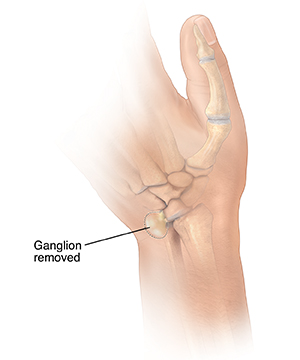
If a ganglion is causing ongoing or severe pain, you may need surgery. Your surgeon removes the whole ganglion wall during the procedure. They may also remove some nearby tissue. If the ganglion has come through a tear in the capsule of the joint, the tear may have to be repaired. The joint will likely be protected while the tear heals.
After surgery
You may feel pain, swelling, numbness, or tingling for some weeks after surgery. See your healthcare provider if you notice any problems in the future. Although surgery is often successful, there is a chance that the ganglion will come back.
Online Medical Reviewer: Joseph, Thomas N., MD
Online Medical Reviewer: Sather, Rita, RN
Date Last Reviewed: 08/01/2023
© 2000-2025 The StayWell Company, LLC. All rights reserved. This information is not intended as a substitute for professional medical care. Always follow your healthcare professional's instructions.
Find the right provider to meet your needs
From primary care to specialty services and more.
Find a Doctor
Call for an Appointment
Offering personalized care at more than 20 clinics across three cities and two states.
Call NowRelated Articles
Total Hip Replacement
Total hip replacement surgery almost always reduces joint pain. During this surgery, your problem hip joint is replaced with an artificial joint, called a prosthesis.
Treatment for Bone Bruise (Bone Contusion)
A bone bruise is an injury to a bone that is less severe than a bone fracture. Bone bruises are fairly common. They can happen to people of all ages.
Kneecap Surgery: Removing Damaged Cartilage
Surgery may be used when pain severely limits your activities. Or it may be done when a rehab program or other nonsurgical treatments just are not helping enough. Some procedures may be done using arthroscopy. This method uses tiny incisions and special instruments to look and work inside the knee joint. Other procedures need open surgery.
Foot Surgery: Curled Fifth Toe
A curled fifth toe is most often inherited. When the fifth toe curls inward, it moves under the next toe. Then the nail of the curled toe starts to face outward. As a result, you may bear weight on the side of your toe instead of the bottom. This can cause corns and painful nails. There are many nonsurgical treatments available. But if these are not effective, surgery is a choice.