To treat a frozen shoulder, stretches are tried first. If stretches alone don’t help, your healthcare provider may suggest adding other treatments. Keep in mind that no treatment replaces shoulder stretches. After any of these treatments, you’ll need to start your exercises again as your healthcare provider advises.
Injection therapy
Your healthcare provider may suggest injection therapy. This does not cure frozen shoulder. But it may reduce pain so that you can do your stretches more comfortably. The injection typically includes two medicines. One is an anesthetic to numb the shoulder. The other is a steroid, such as cortisone, to help reduce painful swelling. It can take from a few hours to a couple of days before the injection starts to have an effect.
Surgical treatment
Surgery may be advised if stretching doesn’t relieve your pain and stiffness. In some cases, both procedures described below are done at the same time:
-
Manipulation. Your healthcare provider slowly raises your arm until the adhesions in the capsule are freed (released). The capsule is the sheet of tough fibers surrounding the bones that make up the shoulder joint.
-
Capsular release. Your provider frees the capsule adhesions through a cut (incision). This may be done if manipulation did not release the capsule. Surgery on the shoulder may be done through a few small incisions. This is called arthroscopic surgery. Or it may be done through one large incision. This is known as open surgery.
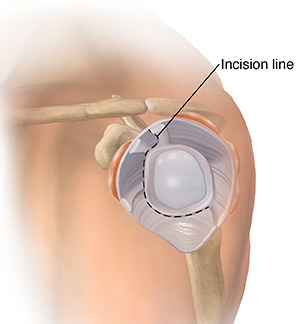
You may start doing shoulder stretches soon after manipulation and capsular release—perhaps even the same day. Your healthcare provider will discuss the plan for your treatment and stretches before the procedure.
Online Medical Reviewer: Joseph, Thomas N., MD
Online Medical Reviewer: Larson, Kim APRN, FNP
Date Last Reviewed: 04/01/2024
© 2000-2025 The StayWell Company, LLC. All rights reserved. This information is not intended as a substitute for professional medical care. Always follow your healthcare professional's instructions.
Find the right provider to meet your needs
From primary care to specialty services and more.
Find a Doctor
Call for an Appointment
Offering personalized care at more than 20 clinics across three cities and two states.
Call NowRelated Articles
Hip Arthroscopy: After Surgery
Know what to expect after arthroscopy on your hip.
Ankle Arthroscopy: Conditions Treated
Arthroscopy is used to find and treat ankle problems. These include loose bodies, bone spurs, osteochondritis dissecans (OCD), and synovitis.
Understanding Upper Arm Fracture Open Reduction and Internal Fixation (ORIF)
Open reduction and internal fixation (ORIF) is a type of treatment to fix a broken bone. It puts the pieces of a broken bone back together so they can heal.
Surgery for Meniscus Tear
Your healthcare provider may use arthroscopy to treat meniscus problems. Learn more about this procedure.