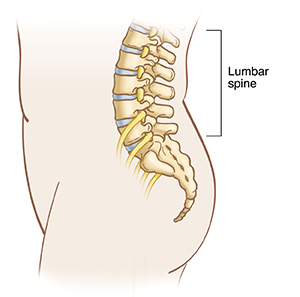
Fusing vertebrae in the lumbar spine may help ease lower back and leg pain. Spinal fusion is fusing two or more vertebrae together so they heal into a single, solid bone. The goal of spinal fusion is to reduce or eliminate painful motion and restore the stability of the spine. Posterior lumbar fusion is done through an incision in your back. Spacers and/or a bone graft are put between the vertebrae. Depending on how many vertebrae are fused, the surgery may take from 3 to 8 hours.
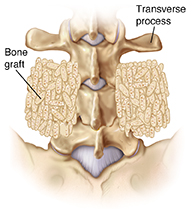
Fusing the transverse processes
Fusion has several steps:
-
The bone graft is packed between the transverse processes (“wings”) on the sides of the vertebrae. This procedure is called posterolateral fusion.
-
To help keep your spine steady and promote fusion, extra support may be used such as titanium screws and rods. Sometimes, bone cement is added around the screws.
-
A wound drain is often placed in the wound and left in for a few days.
-
The incision is closed with stitches (sutures) or staples.
Fusing the disk space
This involves the following:
-
An incision is made in the middle of or on each side of your spine.
-
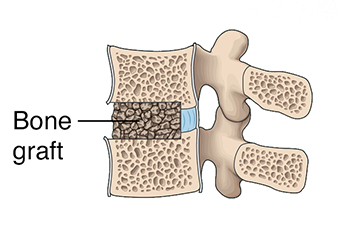
The disk between the vertebrae is removed. This procedure is known as posterior lumbar interbody fusion (PLIF).
-
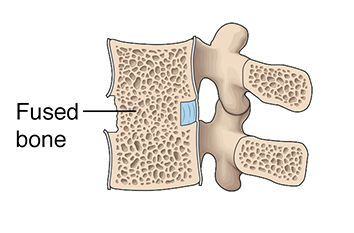
A bone graft, a spacer (cage), or both are placed in the now-empty disk space between the vertebrae. In time, the graft or spacer and the bone will grow into a solid unit.
-
To help keep your spine steady and promote fusion, metal screws, and rods may be placed to provide extra support and promote healing. Sometimes, bone cement is added around the screws.
-
A wound drain is often placed in the wound and left in for a few days.
-
The incision is then closed with stitches or staples.
Online Medical Reviewer: Anne Fetterman RN BSN
Online Medical Reviewer: Heather M Trevino BSN RNC
Online Medical Reviewer: Vinita Wadhawan Researcher
Date Last Reviewed: 03/01/2024
© 2000-2025 The StayWell Company, LLC. All rights reserved. This information is not intended as a substitute for professional medical care. Always follow your healthcare professional's instructions.
Find the right provider to meet your needs
From primary care to specialty services and more.
Find a Doctor
Call for an Appointment
Offering personalized care at more than 20 clinics across three cities and two states.
Call NowRelated Articles
Hip Arthroscopy: After Surgery
Know what to expect after arthroscopy on your hip.
Ankle Arthroscopy: Conditions Treated
Arthroscopy is used to find and treat ankle problems. These include loose bodies, bone spurs, osteochondritis dissecans (OCD), and synovitis.
Understanding Upper Arm Fracture Open Reduction and Internal Fixation (ORIF)
Open reduction and internal fixation (ORIF) is a type of treatment to fix a broken bone. It puts the pieces of a broken bone back together so they can heal.
Surgery for Meniscus Tear
Your healthcare provider may use arthroscopy to treat meniscus problems. Learn more about this procedure.