Once you have been shown how to protect your hip, you will learn the skills needed to return to normal life. You’ll be taught how to walk, sit, and dress.
Sitting and dressing
To protect your new hip, an occupational therapist or physical therapist will teach you safer ways of doing daily tasks. Use the following tips when sitting, dressing, or using stairs.
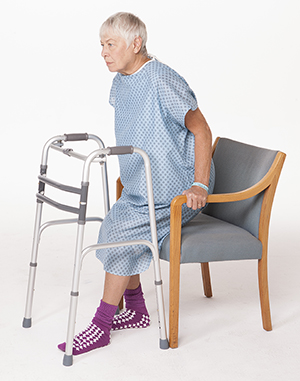
-
To sit, back up until the edge of the chair touches your leg. Then, using the armrests to support your weight, lower yourself into the seat. Always keep your operated leg out in front.
-
To pull on socks and shoes, use a long-handled device, such as a grasper or hook. Try this with slip-on shoes first.
-
To wash your feet and legs, use a long-handled sponge and a shower hose.
-
To use stairs, step up first with your good leg. Then bring your operated leg up to meet it. When going down, step down first with your operated leg.
Going home
You can leave the hospital when your health problem is stable, your pain is controlled, and you’re able to walk safely, including up and down stairs. Once home, it’s normal to have “good” and “bad” days. But if you continue exercising, there will be more good days and your general condition is likely to improve.
Your family’s role
Your family’s support is especially important while you recover and readjust. They can help you make the transition to your home environment. They can remind you of what you learned in the hospital. They can also assist you with equipment until you can use it on your own. Ask your family to encourage you to do things for yourself. They can also cheer you on and celebrate when you walk a little farther, or accomplish a new task.
Planning your discharge
A discharge planner or other healthcare worker meets with you before you’re discharged to arrange for care in another setting or for special equipment you may need at home. A follow-up visit with your surgeon will be arranged, as well as home therapy if it’s needed.
When to call your healthcare provider
Contact your healthcare provider right away if you have:
-
Excessive pain
-
Infection, excessive swelling, redness, warmth, or drainage from your incision
-
A fever of
100.4 °F (38 °C) or higher, or as directed by your healthcare provider -
Shaking chills
-
Calf pain or swelling
Call 911
Call
-
Sudden onset of chest pain or shortness of breath
Online Medical Reviewer: Rahul Banerjee MD
Online Medical Reviewer: Raymond Turley Jr PA-C
Online Medical Reviewer: Stacey Wojcik MBA BSN RN
Date Last Reviewed: 07/01/2023
© 2000-2025 The StayWell Company, LLC. All rights reserved. This information is not intended as a substitute for professional medical care. Always follow your healthcare professional's instructions.
Find the right provider to meet your needs
From primary care to specialty services and more.
Find a Doctor
Call for an Appointment
Offering personalized care at more than 20 clinics across three cities and two states.
Call NowRelated Articles
Protecting Your Foot After Foot Surgery
To help the bone heal properly, you may need to wear a cast. If you do, always keep it dry. Your healthcare provider will tell you whether you can bear weight on your foot while it heals. They may also prescribe a surgical shoe for you to wear.
Using Crutches with Swing To (Non-Weight Bearing)
These images show the use of crutches with swing to.
Discharge Instructions for Elbow Arthroscopy
Instructions for taking care of yourself after elbow arthroscopy.
Discharge Instructions for Knee Arthroscopy
Information on how to care for yourself after knee arthroscopy.