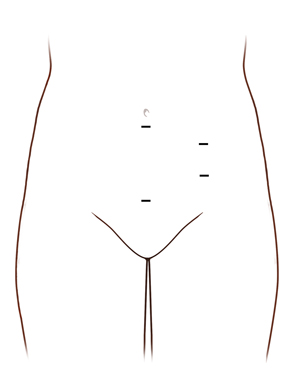
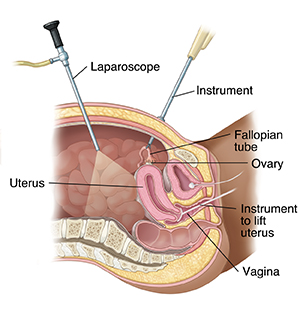
Laparoscopy is a surgical procedure. It lets the surgeon see your reproductive organs up close. After you are given anesthesia, small cuts (incisions) are made in your belly (abdomen). A laparoscope is put into one of the small incisions. A laparoscope is a long, thin tube with a camera on the end. It sends pictures to a video screen. The surgeon can see inside the body. Surgical tools are put through the other incisions to complete the procedure.
A closer look
Your surgeon needs to see clearly during surgery. To do this, your abdomen is inflated with a harmless gas. A device may be put into the vagina to lift the uterus. This helps your surgeon see your organs better through the scope.
Risks and possible complications of surgery
These may include:
-
Infection.
-
Bleeding.
-
Damage to blood vessels, nerves, muscles, uterus, ovaries, fallopian tubes, bowel, bladder, or ureters.
-
Risks of anesthesia.
-
Blood clots.
-
Hernia at the incision site.
-
Need for a larger incision.
Featured in
Online Medical Reviewer: Daniel N Sacks MD
Online Medical Reviewer: Donna Freeborn PhD CNM FNP
Online Medical Reviewer: Heather Trevino
Date Last Reviewed: 03/01/2025
© 2000-2025 The StayWell Company, LLC. All rights reserved. This information is not intended as a substitute for professional medical care. Always follow your healthcare professional's instructions.
Compassionate Care for Women
San Juan Health Partners Obstetrics & Gynecology. With two locations serving Four Corners women.
Find a Doctor
Call for an Appointment
Offering personalized care at more than 20 clinics across three cities and two states.
Call NowRelated Articles
Hysterosalpingogram (HSG)
HSG is an X-ray test used to view your uterus and fallopian tubes. It's most often used to help diagnose why you are not able to get pregnant.
Tubal Sterilization Surgery
Tubal sterilization is one of the most effective forms of birth control. It blocks the egg from being fertilized by sperm. This prevents pregnancy.
Pelvic Organ Prolapse: Surgery for Incontinence
Urinary incontinence (urine leakage) can be treated during pelvic organ prolapse surgery. The goal of surgery is to hold the urethra and bladder firmly in place to prevent leakage and relieve your symptoms.
Thinking About Hysterectomy
Before advising a hysterectomy, your healthcare provider will evaluate your health problem. You and your healthcare provider will go over the results of your exams and tests. Together, you can discuss your choices and make a treatment plan.