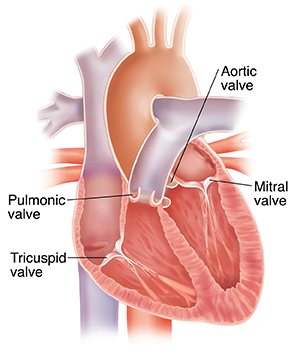
The heart has four valves. They are the aortic, pulmonary, tricuspid, and mitral valves. The valves open and close to keep blood moving in the right direction through the heart. Blood moves through the heart as it beats. With each squeeze, the valves open and close to keep blood moving forward. In this way, valves keep blood moving as well as possible through the heart. They also prevent backflow.
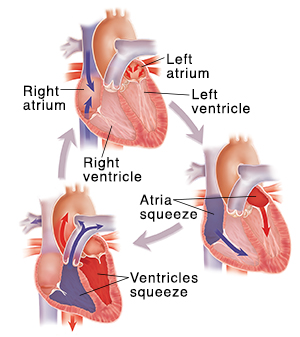
When the heart relaxes between beats:
-
Oxygen-rich blood from the lungs fills the left atrium.
-
Oxygen-poor blood from the body fills the right atrium.
When the atria beat:
-
The left atrium squeezes. This pushes blood through the mitral valve into the left ventricle.
-
The right atrium squeezes. This pushes blood through the tricuspid valve into the right ventricle.
When the ventricles beat:
-
The left ventricle squeezes. This pushes blood through the aortic valve out to the heart arteries, the brain, and body.
-
The right ventricle squeezes. This pushes blood through the pulmonary valve to the lungs.
Online Medical Reviewer: Glenn Gandelman MD MPH
Online Medical Reviewer: Lu Cunningham RN BSN
Date Last Reviewed: 08/01/2023
© 2000-2025 The StayWell Company, LLC. All rights reserved. This information is not intended as a substitute for professional medical care. Always follow your healthcare professional's instructions.
Find the right provider to meet your needs
From primary care to specialty services and more.
Find a Doctor
Call for an Appointment
Offering personalized care at more than 20 clinics across three cities and two states.
Call NowRelated Articles
Left-sided heart failure
Left-sided heart failure can cause shortness of breath and trouble breathing. Learn about treatment and home care for this condition.
Right-Sided Heart Failure
Swelling in the feet and ankles is one of the first signs of right-sided heart failure. Learn how this condition is treated.
Ventricular Arrhythmia
Sometimes problems with the heart's electrical signals lead to a fast heart rhythm. Too many signals may make the heart beat very fast (tachycardia). Or signals may be sent so rapidly and irregularly that the heart muscle sometimes quivers and doesn't beat at all (fibrillation).
Unstable Angina
There are 2 types of angina, stable and unstable. Stable angina occurs at certain times and can often be managed. Unstable angina occurs at uncertain times. It may not get better with the usual forms of treatment for angina. It is a warning that a heart attack (acute myocardial infarction) is possible in the near future.