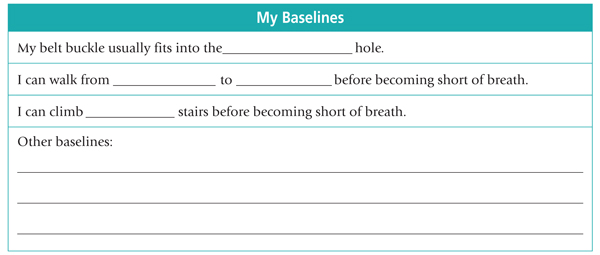
The first step to managing heart failure symptoms is getting to know what’s normal for you. How much can you usually do before shortness of breath is a problem? Do your socks and shoes fit comfortably? How much do you weigh? How your symptoms usually feel are your baselines. Knowing what’s normal for you will help you see when symptoms are getting worse. You’ll know because you won’t feel normal anymore. Symptoms that get worse means your heart is under stress. It's having a hard time pumping blood to the rest of your body, and your body may be retaining fluid. Write some baselines in the box below. These will help you measure your symptoms.

Watch for changes
Once you’ve come up with baselines, watch for changes daily. Pay attention to how much you can do today. Is it the same as yesterday? Are your shoes tight? Do you need to use a different belt hole? Can you lie flat in bed to sleep without feeling that you are suffocating? Can you eat without feeling full too soon, or short of breath? Are you gaining weight but eating the same amount?
If today’s symptoms are different from your baselines, you need to take action. The problem won’t go away by itself. So, if you notice even a small change, don’t ignore it. Your health care provider is counting on you to call when you think your symptoms are worse. They will tell you what to do next. Working together this way helps keep heart failure under control and improves the number of good days you have. It could even keep you out of the hospital.
Online Medical Reviewer: Ronald Karlin MD
Online Medical Reviewer: Stacey Wojcik MBA BSN RN
Online Medical Reviewer: Steven Kang MD
Date Last Reviewed: 02/01/2025
© 2000-2025 The StayWell Company, LLC. All rights reserved. This information is not intended as a substitute for professional medical care. Always follow your healthcare professional's instructions.
Find the right provider to meet your needs
From primary care to specialty services and more.
Find a Doctor
Call for an Appointment
Offering personalized care at more than 20 clinics across three cities and two states.
Call NowRelated Articles
Eating Heart-Healthy Food: Using the DASH Plan
Eating healthy for your heart doesn't have to be hard or boring. You just need to know how to make healthier choices. That means eating mostly foods that are low in fat and high in fiber.
Medicine for Cholesterol Control
Medicine can give you the extra help you need to control your cholesterol. If medicine is prescribed, be sure to take it exactly as directed.
For Warfarin: Eating a Consistent Vitamin K Diet
If you take the blood-thinner warfarin, you’ll need to watch the amount of vitamin K in your diet. Keep the amount you eat about the same from day to day.
Intimacy and Heart Disease: Resuming Sexual Intimacy
When you both feel ready for sex, start slowly. Having sex with a partner you know well doesn't cause a heart attack. In fact, it takes only about as much energy as climbing two flights of stairs. Here are tips for resuming safe sexual intimacy.