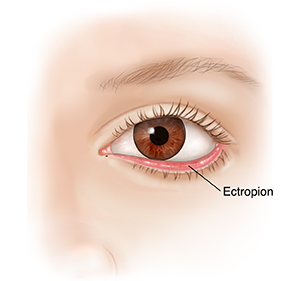
Ectropion is an eyelid that sags or turns outward. It can affect just one lower eyelid. Or it can affect both lower eyelids. Ectropion leaves the eye too exposed. The eye can become dry and irritated. And even infected. This can lead to serious problems. It can lead to loss of eyesight in some cases.
What causes ectropion?
Congenital ectropion is present from birth. There is not enough skin on the lower eyelid. This rare form may happen because of problems with some genes. This most often occurs along with health problems, such as:
-
Blepharophimosis syndrome
-
Down syndrome
-
Ichthyosis
Acquired ectropion happens later in life. You weren't born with it. There are 4 different types:
-
Involutional ectropion. This is the most common type of ectropion. It's often due to aging. It's most common in older adults. Over time the collagen and elastic fibers in the eyelid can get weak. This causes the eyelid tissue to become very loose. Gravity can then cause the eyelid to fall open.
-
Cicatricial ectropion. This is a rare type of ectropion. It’s caused when the lower lid contracts abnormally from shortening of the skin and muscle. This is often from scarring that causes the lid to open outward. This may happen because of an eye infection or eye injury. Or problems after eye surgery. A bacterial infection called trachoma is a common cause of this kind of ectropion.
-
Paralytic ectropion. This is also a rare type of ectropion. This is due to a problem with the facial nerve (seventh cranial nerve). This nerve sends signals to the muscle right under the eye. Problems with the nerve can cause other problems in facial movement. Cranial nerve paralysis may occur because of a stroke.
-
Mechanical ectropion. This is another rare type. This happens when a tumor or other mass in the eyelid pulls it down.
Symptoms of ectropion
Symptoms are caused by the front part of the eye (cornea) and lining of the eye (conjunctiva) being exposed. They can include:
-
Excessive tearing
-
Dry eyes
-
Itching, burning, or crusting, from chronic conjunctivitis
-
Blurry eyesight, sensitivity to light, and eye pain. These are from an infection or ulcer of the cornea.
-
Inability to fully close the eyelids, especially with paralytic ectropion
Diagnosing ectropion
Your eye care provider will ask about your past health. They will give you an eye exam. Tests are not needed to diagnose ectropion.
Treatment for ectropion
You may first use treatments, such as:
-
Lubricating eye drops, such as artificial tears
-
Steroid ointment in the eyes
-
Antibiotics to treat an eye infection
-
Taping the eyelid into normal position, most often at night
Most people with ectropion will need surgery. The type of surgery used depends on the cause of the ectropion. For example, you may need extra skin removed. Or you may need a donor skin graft to add more skin under your eye. You may need a tumor removed from your eyelid. Surgery successfully treats ectropion in most cases.
Possible complications of ectropion
Ectropion can cause infection of the cornea. This leads to a corneal ulcer. And it may cause scarring of the cornea and loss of eyesight.
When to call your healthcare provider
Call your healthcare provider right away if any of the following occur:
-
Eye pain
-
Decreased vision
-
Eye redness that gets worse
-
Sensitivity to light that gets worse
-
Blurry eyesight
-
Fluid coming from your eye
Online Medical Reviewer: Chris Haupert MD
Online Medical Reviewer: Tara Novick BSN MSN
Online Medical Reviewer: Whitney Seltman MD
Date Last Reviewed: 11/01/2022
© 2000-2025 The StayWell Company, LLC. All rights reserved. This information is not intended as a substitute for professional medical care. Always follow your healthcare professional's instructions.
Find the right provider to meet your needs
From primary care to specialty services and more.
Find a Doctor
Call for an Appointment
Offering personalized care at more than 20 clinics across three cities and two states.
Call NowRelated Articles
Blood in Eye (Vitreous Hemorrhage)
The vitreous is the clear, thick gel inside your eyeball. A hemorrhage means there is some blood in it.
Conjunctivitis Caused by Irritation
Conjunctivitis may be caused by allergies or other irritants. The problem can keep coming back. Sometimes an eye infection will result. Treatment involves relieving the symptoms and avoiding the cause of the irritation.
Understanding Keratoconus
Keratoconus is an eye disorder where your cornea thins slowly over time. It happens more often in young adults in their teens and 20s.
Understanding Focusing Problems
Your vision depends on how light is focused in your eye. A look at 3 common problems with focusing that make vision blurry: farsightedness, nearsightedness, and astigmatism.