Food poisoning (foodborne illness) usually happens when food is not prepared or stored safely. Germs (bacteria) can grow in food if it is not handled right. Germs can also grow on any surface, including cutting boards and sponges. When germs or poisons they make get inside your body, they can cause diarrhea, vomiting, and headache. In some cases, food poisoning can be fatal if it is not treated right away.
Look before you buy
-
Check the sell-by date on all foods.
-
Check that seals and wrappers are not broken, torn, or leaking.
-
Make sure cans are not bulging or dented, jars are not cracked, and lids are closed tightly.
-
Check that eggs are not cracked or broken.
Wash everything
-
Wash your hands often with warm, soapy water. Always wash your hands after you touch raw meat or poultry.
-
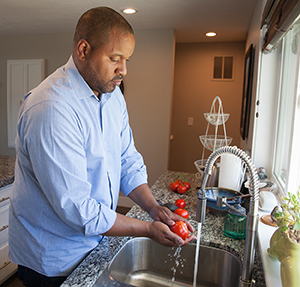
Rinse all fruits and vegetables.
-
Wash knives, forks, plates, and other items that touch food.
-
Wash cutting boards in hot, soapy water. Use 1 cutting board and 1 knife for meat and poultry. Use another for fruits and vegetables. Replace them often.
-
Clean kitchen counters before and after putting food on them.
-
Wash sponges each day. Replace them often.
-
Wash dishcloths and towels in hot, soapy water. Use 1 towel for hands and another for dishes.
-
Don't use the same wash rags to clean the bathroom and the kitchen.
Safe food storage tips
-
Put leftovers in your refrigerator right away.
-
Divide foods into small, shallow pans to cool faster.
-
Throw away food that has been left out for more than 2 hours.
Keep hot foods hot
Cook meats to a safe temperature to kill E. coli and other bacteria that may be in the meat. Use a food thermometer when cooking. Follow these temperature guidelines when cooking meat:
-
Cook ground meat (beef, veal, pork, lamb) and meat mixtures to at least 160°F (71°C).
-
Cook fresh beef, veal, lamb, and pork (steak, roasts, chops), and fish to at least 145°F (63°C).
-
Cook poultry (including ground turkey and chicken) and any leftovers and casseroles to an internal temperature of at least 165°F (74°C).
-
Cook egg dishes such as quiches and frittatas to at least 160°F (71°C).
Also be sure to:
-
Cook eggs until the yolks and whites are firm.
-
Cook chicken stuffing or turkey stuffing separately. Don’t cook it inside the bird.
Keep cold foods cold
-
Cold foods should stay below 40°F (4°C).
-
Put cold foods in the refrigerator or freezer as soon as you bring them home. Don’t leave them in the car while running other errands.
-
Defrost frozen food in the refrigerator or in the microwave. Don't defrost on the counter.
-
Pack picnics and school lunches in an insulated bag with an ice pack.
Keep raw foods away from cooked foods
-
Never place cooked meat and poultry on a plate with raw meat juices.
-
Store raw meats and poultry on the lowest shelf or storage bin in the refrigerator. This prevents juices from dripping down onto other foods.
-
Don't reuse a marinade or pour it over cooked food.
-
Don't eat raw meat, seafood, shellfish, eggs, or drink unpasteurized milk.
Online Medical Reviewer: Brittany Poulson MDA RDN CD CDE
Online Medical Reviewer: Diane Horowitz MD
Online Medical Reviewer: Heather M Trevino BSN RNC
Date Last Reviewed: 12/01/2022
© 2000-2025 The StayWell Company, LLC. All rights reserved. This information is not intended as a substitute for professional medical care. Always follow your healthcare professional's instructions.
Find the right provider to meet your needs
From primary care to specialty services and more.
Find a Doctor
Call for an Appointment
Offering personalized care at more than 20 clinics across three cities and two states.
Call NowRelated Articles
Understanding Chickenpox
Chickenpox is a viral illness that spreads very easily from person to person. The virus that causes chickenpox can stay in the body after the illness and later cause shingles. Learn about its symptoms and how it's treated.
Lumbar Puncture
A lumbar puncture is also called a spinal tap. It may be used to look for problems in your brain, spinal cord, and related structures.
Understanding Cold Sores
Cold sores are small blisters or sores on the lip or sometimes inside the mouth. Learn what causes them, their symptoms, and how to prevent them.
COVID-19: Vaccines and Prevention
The best prevention is to not have contact with the COVID-19 virus. Read on about vaccines and other ways to protect yourself and others.