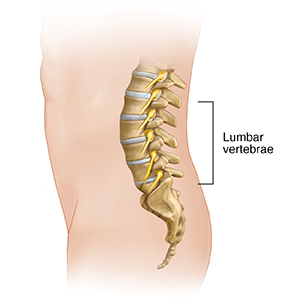
Spinal fusion surgery is performed to connect two or more bones in the spine so that they heal into a single, solid bone. These bones are called vertebrae. Fusing vertebrae in the lower (lumbar) spine may help ease lower back and leg pain.
A lumbar fusion is an effective and popular surgical procedure to restore the intervertebral disc space and stabilize the spine. Anterior lumbar interbody fusion (ALIF) is done through an incision in your abdomen. The surgery may take from 3 to 8 hours. This depends on how many vertebrae are fused. In some people, an ALIF is combined with a posterior instrumented fusion (PIF). This is done through an incision in the back.
The fusion procedure
Here is what to expect:
-
An incision is made on one side of your abdomen.
-
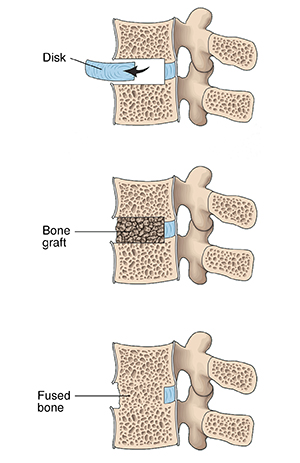
The disk is removed from between the vertebrae that require fusion. This leaves an empty space between the vertebrae.
-
A bone, synthetic, or metal graft is placed into the empty space.
-
The graft may be held in place with screws or a plate with screws. Over time, the graft and the bone around it grow into one solid unit.
-
A tube called a drain may be left in the wound for a few days.
-
The incision is closed with sutures or staples.
Online Medical Reviewer: Anne Fetterman RN BSN
Online Medical Reviewer: Heather M Trevino BSN RNC
Online Medical Reviewer: Vinita Wadhawan Researcher
Date Last Reviewed: 03/01/2024
© 2000-2025 The StayWell Company, LLC. All rights reserved. This information is not intended as a substitute for professional medical care. Always follow your healthcare professional's instructions.
Find the right provider to meet your needs
From primary care to specialty services and more.
Find a Doctor
Call for an Appointment
Offering personalized care at more than 20 clinics across three cities and two states.
Call NowRelated Articles
Medicines for Partial Seizures
For most people, medicines can control partial seizures. But there are many kinds of partial seizures, so it may take some time to find the best medicines for you. Your healthcare provider may try several kinds of medicines at varying doses before finding what works best for you. You can help make medicines a success by following these suggestions.
During Cervical Disk Surgery
During surgery, your surgeon may remove all or part of the disk (diskectomy). To reach the cervical spine, they may make an incision in the front (anterior) or the back (posterior) of your neck. Learn more about these 2 approaches.
Lumbar Drain Placement
A lumbar drain is a soft, thin, sterile tube (also called a catheter) that your healthcare provider places though the skin of your back, into your lower (lumbar) spine. The drain collects cerebrospinal fluid (CSF). This is a clear fluid that surrounds your spinal cord and brain to protect them from injury. Read on to learn more about lumbar drain placement and how it’s done.
First Aid: Head Injuries
A strong blow to the head may cause swelling and bleeding inside the skull. The resulting pressure can injure the brain (concussion).