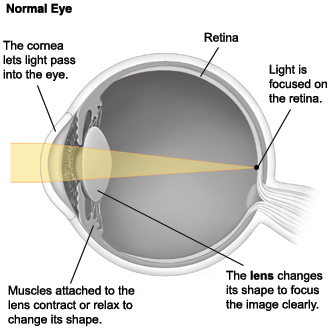
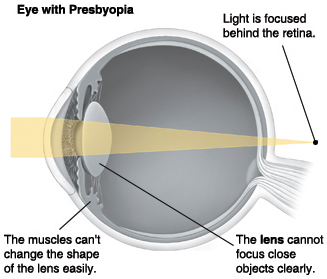
Presbyopia is the loss of close-up focusing. It's not a disease. It is a normal aging process of the eye. When you are younger, the lens in your eye changes shape to focus light directly on the back of your eye (the retina). But as you get older, the lens hardens and can't change its shape as easily. It then can’t focus clearly on close objects. This makes them look blurry.
What are the symptoms?
Presbyopia makes it hard to do things close-up. This includes reading small print, using tools, and threading a needle. The first sign may be a tired feeling when you look at something close-up. Presbyopia most often starts when you’re 40 to 45 years old. But it can start at an earlier age.
Online Medical Reviewer: Chris Haupert MD
Online Medical Reviewer: Raymond Kent Turley BSN MSN RN
Online Medical Reviewer: Rita Sather RN
Date Last Reviewed: 12/01/2022
© 2000-2025 The StayWell Company, LLC. All rights reserved. This information is not intended as a substitute for professional medical care. Always follow your healthcare professional's instructions.
Find the right provider to meet your needs
From primary care to specialty services and more.
Find a Doctor
Call for an Appointment
Offering personalized care at more than 20 clinics across three cities and two states.
Call NowRelated Articles
Understanding Corneal Ulcer
A corneal ulcer is an open sore on your cornea. In most cases, it's caused by an infection.
What Is Low Vision?
When you have low vision, you can't see well enough to get around or do daily activities. Regular glasses or contact lenses may not help. Your central or side vision, or both, may be reduced.
Temporal Arteritis
Symptoms of temporal arteritis include headache, tenderness of the temples or scalp, jaw pain when chewing, muscle aches, fatigue, fever, and unintentional weight loss.
Acquired Brown Syndrome (Superior Oblique Tendon Sheath Syndrome)
Brown syndrome is a problem with a tendon that attaches to the eyeball. In Brown syndrome, this tendon can’t move freely. This limits the eye’s normal movement. Brown syndrome is a rare disorder. It is usually present at birth (congenital). In some cases, it occurs later in life (acquired).