How is a stroke diagnosed?
Your healthcare provider will ask you about your health history. They will give you a physical exam. You may also have these tests to diagnose a stroke.
Imaging tests of the brain
-
CT scan. This test uses X-rays and a computer to make pictures of the body. A CT scan shows detailed images of any part of the body. This includes bones, muscles, fat, and organs. CT scans are used to find changes or defects. They can also help find the site or type of stroke.
-
MRI scan. This test uses large magnets, radio waves, and a computer without the use of X-ray. It makes detailed images of tissues in the body. It uses magnetic fields to see small changes in brain tissue. This helps to find and diagnose stroke.
-
Radionuclide angiography. This is a type of nuclear brain scan. It is only done in special cases. A radioactive tracer is injected into a vein in the arm. Then a machine creates a map showing the tracer's movement to different parts of the head. This shows how the brain works. It can often find areas of reduced blood flow and tissue damage.
-
CT angiography. This test uses CT scan technology to get images of blood vessels by injecting a contrast material.
-
Magnetic resonance angiography. This test checks blood flow through arteries using MRI technology by injecting a contrast material.
-
Conventional cerebral angiogram. A tube (catheter) is used to check cerebral blood. It can find the exact site of the blood vessel blockage.
Tests that assess the brain's electrical activity
-
Electroencephalogram (EEG). This test records the brain's electrical signals. It uses electrodes put on your scalp. This can be a routine EEG study. Or it may be ongoing, long-term monitoring.
-
Evoked potentials. These tests record the brain's electrical response to light, sound, and touch.
Tests that measure blood flow
-
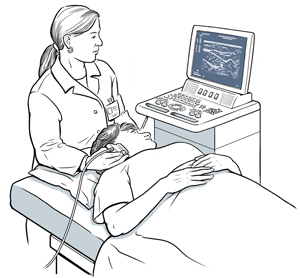
Doppler sonography (carotid ultrasound). A handheld probe (transducer) sends sound waves into a blood vessel to check blood flow. A very faint sound, or no sound, may mean a problem with blood flow.
-
Transcranial Doppler ultrasonography. A transducer is used to send sound waves through the skull. This can find problems with the blood vessels below.
-
Ocular plethysmography. This test measures pressure on the eyes. It can also finds pulses in the eyes.
-
Cerebral blood flow test (inhalation method). This test measures the amount of oxygen in the blood supply that reaches different areas of the brain.
-
Digital subtraction angiography. This test makes an image of the blood vessels in the brain. This is used to find a problem with blood flow. A small, thin tube (catheter) is placed in a leg artery. It is passed up to the blood vessels in the brain. A contrast dye is injected into the catheter. Then X-ray images are taken.
Online Medical Reviewer: Deepak Sudheendra MD
Online Medical Reviewer: Raymond Kent Turley BSN MSN RN
Online Medical Reviewer: Rita Sather RN
Date Last Reviewed: 07/01/2023
© 2000-2025 The StayWell Company, LLC. All rights reserved. This information is not intended as a substitute for professional medical care. Always follow your healthcare professional's instructions.
Find the right provider to meet your needs
From primary care to specialty services and more.
Find a Doctor
Call for an Appointment
Offering personalized care at more than 20 clinics across three cities and two states.
Call NowRelated Articles
Magnetic Resonance Imaging (MRI) of the Spine and Brain
Magnetic resonance imaging (MRI) uses a large magnet, radiofrequencies, and a computer to make detailed images of organs and structures within the body, in this case, the brain and spine. MRI is used to help diagnose a health problem.
Computed Tomography (CT) Scan of the Brain
A computed tomography (CT) scan is an imaging test that uses X-rays and a computer to make detailed images of the body. A CT scan shows details of the bones, muscles, fat, and organs.
Lumbar Puncture Fact Sheet
Your healthcare provider has advised you to have a lumbar puncture. Read on to learn more about this test.
Understanding Carotid Dissection
A carotid dissection is a tear in the inner layer of an artery in the neck. You have one carotid artery on each side of your neck. These arteries send blood to your brain.