Anatomy of the biliary system
The biliary system consists of the organs and ducts that help to make and transport bile. These include the bile ducts, gallbladder, and related structures.
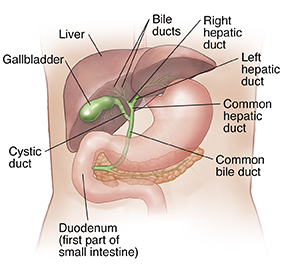
The transportation of bile follows this sequence:
-
When the liver cells secrete bile, it is collected by a system of ducts that flow from the liver through the right and left hepatic ducts.
-
These ducts ultimately drain into the common hepatic duct.
-
The common hepatic duct then joins with the cystic duct from the gallbladder to form the common bile duct. This runs from the liver to the first section of the small intestine (the duodenum).
-
But not all bile runs directly into the duodenum. About half of the bile produced by the liver is first stored in the gallbladder. This is a pear-shaped organ located directly below the liver.
-
Then, when food is eaten, the gallbladder contracts and releases stored bile into the duodenum to help break down the fats.
Functions of the biliary system
The biliary system's main function includes the following:
-
To drain waste products from the liver into the duodenum
-
To help in digestion with the controlled release of bile
Bile is the greenish-yellow fluid (made of waste products, cholesterol, and bile salts) that is secreted by the liver cells to do these two main functions:
-
Carry away waste
-
Break down fats during digestion
Bile salt is the actual component that helps break down and absorb fats. Bile, which is excreted from the body in the form of stool (feces), is what gives stool its dark brown color.
Online Medical Reviewer: Jen Lehrer MD
Online Medical Reviewer: Raymond Kent Turley BSN MSN RN
Online Medical Reviewer: Rita Sather RN
Date Last Reviewed: 01/01/2023
© 2000-2025 The StayWell Company, LLC. All rights reserved. This information is not intended as a substitute for professional medical care. Always follow your healthcare professional's instructions.
Find the right provider to meet your needs
From primary care to specialty services and more.
Find a Doctor
Call for an Appointment
Offering personalized care at more than 20 clinics across three cities and two states.
Call NowRelated Articles
The Digestive Process: What Does the Small Intestine Do?
At 20 feet long, your small intestine is the longest part of the human digestive system. Most of the digestive process takes place there.
The Digestive Process: Digestion Begins in the Mouth
Digestion is a multistep process that begins the moment you place a piece of food in your mouth or sip some juice.
What Is GERD?
If you often have a painful burning feeling in your chest after you eat, you may have GERD (gastroesophageal reflux disease).
How Food Moves Through Your Body
Here is an explanation of how food moves through your body and what each part of your digestive tract does.