Types
Knees Are Casualties of Women's Sports
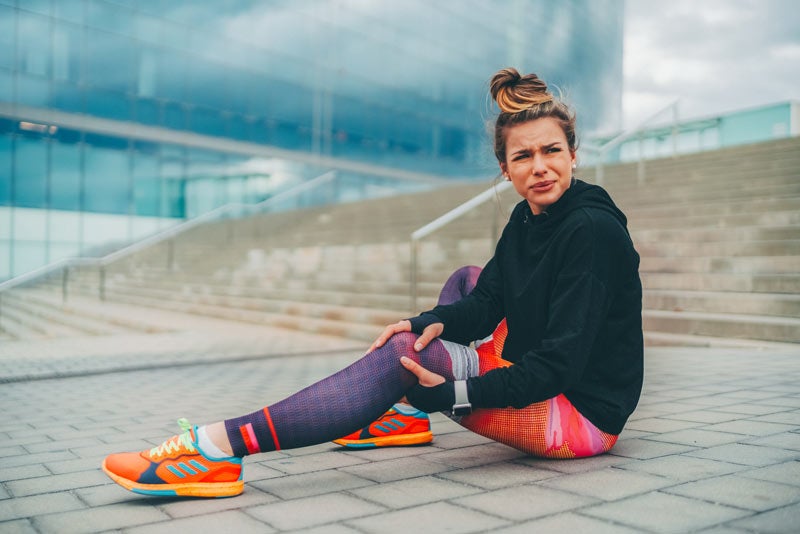
Active women are at least twice as likely to suffer serious knee injuries as men, but it's not just athletes who are at risk.
Although female athletes at the high school and college level can suffer serious knee injuries, people who play recreational volleyball or participate in step aerobics also can injure their knees, says the American Academy of Orthopaedic Surgeons (AAOS). A parent who carries their child down a flight of steps and misses the last step also can injure their knee. In short, a knee injury can happen to any person, no matter how athletic they are.
The chief movements that cause knee problems in women are pivoting and landing from a jump, the AAOS says.
Luckily, you can protect yourself by getting into better shape, knowing your strength, controlling your weight, and exercising your leg muscles.
Anatomy of the problem
Why are female knees, in a sense, an Achilles heel?
Since a female has a wider pelvis, their femur (thigh bone) descends into the knee at an inward angle.
When a person becomes extremely tired, as during an athletic event, the angle on landing becomes more pronounced, further increasing the chance of injury.
A band of fibrous connective tissue called the anterior cruciate ligament (ACL) passes through a "notch" in the lower end of the thighbone that forms part of the knee. The ligament, one of several that attach the upper and lower leg bones, is about the same size for a woman as a man. But the notch is narrower in females. That makes the female's ligament more susceptible to tearing.
A female's hamstring muscles, at the back of the thigh, are often weak compared with their quadriceps, the muscles at the front of the thigh. The quadriceps pull the bones of the lower leg forward, and the hamstrings pull them back. Hamstring muscles help protect the ACL from injury. When the pulling power is out of balance, the knees suffer.
The muscle imbalance tends to be far worse in women than in men. The imbalance may begin to happen during childhood if girls engage in less physical activity. Exercise can help overcome the problem.
Risk of injury to the ACL appears to be higher during ovulation, when estrogen levels are highest. The ACL appears to respond to estrogen by decreasing cell activity to repair basic ligament fibers called collagen.
Strengthen your legs
Strengthening exercises are especially important for your hamstrings. Try hamstring curls: Lying on your belly, draw your lower legs upward, and try to touch your heel to your buttock. Use resistance equal to about 10% of your body weight. Do a few sets of 10 to 15 repetitions; hold them a second or two.
Jumping exercises are also critical for building strength and preventing knee injuries. When you land from a jump, keep it soft. Come down on the balls of your feet and slowly roll back to the heel. Keep your knees bent and your hips straight. Try to keep your knee in line with your foot.
Hopping over a cone side to side and forward and backward builds strength and control:
-
Place a 6-inch cone on your left. Hop over the cone with both feet, concentrating on a soft landing. Repeat by hopping back over the cone to the right. Repeat for a total of 20 hops.
-
Place the cone in front of you. Hop over the cone with both feet, then hop backward over the cone. Keep your knees slightly bent when you land. Repeat for a total of 20 hops.
-
Repeat the above forward and backward exercise but hop with one leg at a time. Again, keep your knee slightly bent when you land. Do 20 hops on each leg.
Other knee tips
-
Improve your overall strength and fitness.
-
Know your level of fitness and the demands of your sport or activity.
-
Control your weight. When you walk, each extra pound adds 4 pounds of pressure to the kneecap. That pound adds 20 pounds of pressure when climbing steps.
-
Buy sturdy shoes made for your activity and replace them when the inner or outer soles appear worn.
Featured in
Author: Bramnick, Jeffrey
Online Medical Reviewer: L Renee Watson MSN RN
Online Medical Reviewer: Rahul Banerjee MD
Online Medical Reviewer: Rita Sather RN
Date Last Reviewed: 01/01/2023
© 2000-2025 The StayWell Company, LLC. All rights reserved. This information is not intended as a substitute for professional medical care. Always follow your healthcare professional's instructions.
Find the right provider to meet your needs
From primary care to specialty services and more.
Find a Doctor
Call for an Appointment
Offering personalized care at more than 20 clinics across three cities and two states.
Call NowRelated Articles
Understanding a Clavicle Fracture
A fracture of the clavicle is a broken collarbone. Clavicle fractures occur most often along the middle of the bone. Depending on how badly the bone is broken, healing may take a few months or longer.
Back Pain (Acute or Chronic)
Back pain is 1 of the most common problems. The good news is that most people feel better in 1 to 2 weeks, and most of the rest in 1 to 2 months. Most people can remain active.
Sacroiliitis
Sacroiliitis is when one or both sacroiliac joints are hurt or inflamed. It can make small movements of the lower back and pelvis very painful. Learn how to care for yourself at home.
Broken Foot
You have a broken bone (fracture) in your foot. This will cause pain, swelling, and sometimes bruising. It will take about 4 to 6 weeks to heal. A foot fracture may be treated with a special shoe, splint, cast, or boot.