What is the ear?
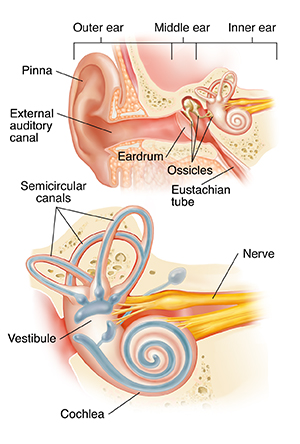
The ear is the organ of hearing and balance. The parts of the ear include:
-
External or outer ear, consisting of:
-
Pinna or auricle. This is the outside part of the ear.
-
External auditory canal or tube. This is the tube that connects the outer ear to the inside or middle ear.
-
-
Tympanic membrane (eardrum). The tympanic membrane divides the external ear from the middle ear.
-
Middle ear (tympanic cavity), consisting of:
-
Ossicles. Three small bones that are connected and send the sound waves to the inner ear. The bones are called:
-
Malleus
-
Incus
-
Stapes
-
-
Eustachian tube. A canal that links the middle ear with the back of the nose. The eustachian tube helps to equalize the pressure in the middle ear. Equalized pressure is needed for the correct transfer of sound waves. The eustachian tube is lined with mucous, just like the inside of the nose and throat.
-
-
Inner ear, consisting of:
-
Cochlea. This contains the nerves for hearing.
-
Vestibule. This contains receptors for balance.
-
Semicircular canals. This contains receptors for balance.
-
How do you hear?
Hearing starts with the outer ear. When a sound is made outside the outer ear, the sound waves, or vibrations, travel down the external auditory canal and strike the eardrum (tympanic membrane). The eardrum vibrates. The vibrations are then passed to 3 tiny bones in the middle ear called the ossicles. The ossicles amplify the sound. They send the sound waves to the inner ear and into the fluid-filled hearing organ (cochlea).
Once the sound waves reach the inner ear, they are converted into electrical impulses. The auditory nerve sends these impulses to the brain. The brain then translates these electrical impulses as sound.
Online Medical Reviewer: Ashutosh Kacker MD
Online Medical Reviewer: Rita Sather RN
Online Medical Reviewer: Tara Novick BSN MSN
Date Last Reviewed: 01/01/2023
© 2000-2025 The StayWell Company, LLC. All rights reserved. This information is not intended as a substitute for professional medical care. Always follow your healthcare professional's instructions.
Find the right provider to meet your needs
From primary care to specialty services and more.
Find a Doctor
Call for an Appointment
Offering personalized care at more than 20 clinics across three cities and two states.
Call NowRelated Articles
Understanding Nasal Anatomy: Outside View
Why does your nose look the way it does? And what goes on inside a nose to let a person breathe easily? Learning the anatomy of the nose can help you better understand the answers to these questions.
The Middle Ear
The middle ear is an air-filled chamber that lies behind the eardrum. Pressure in the middle ear changes to match air pressure outside of the eardrum. When inside and outside pressures are balanced, the eardrum is flexible and normal hearing is more likely. Problems happen when air pressure in the middle ear drops. This is often due to a block in the eustachian (u-STA-shun) tube, the narrow channel connecting the ear with the back of the throat.
Anatomy and Physiology of the Nose and Throat
A helpful guide to the nose, the sinuses, and the throat.
Audiology
Audiologists address hearing and balance problems in people of all ages. They also help with the fitting and management of hearing aids.