Healthcare professions experience some of the highest rates of musculoskeletal injuries compared to all other industries in the United States. At work, you perform many tasks every day that could cause an injury to your back, wrist, arms, or knees. These include repeated lifting, prolonged standing, bending, twisting, reaching, pushing, and pulling. Good stance or posture can protect you from such injuries besides making everyday tasks easier.
A balanced spine
-
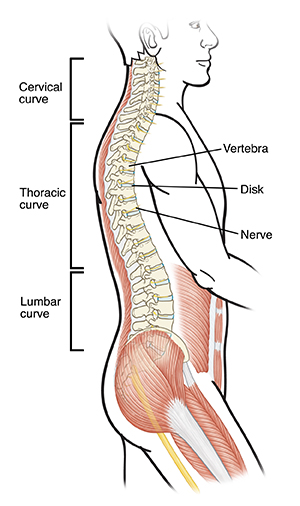
A balanced spine is made of bones (vertebrae) and pads of cartilage (disks) arranged in 3 natural curves.
-
Your neck (cervical curve) supports your head. And your middle back (thoracic curve) is supported by your rib cage.
-
Your lower back (lumbar curve) carries more than its fair share, balancing your entire upper body. This extra load and the mobility of the lumbar curve make it the most susceptible to injury. The core muscle groups (of the abdominal, gluteal, and hip regions) support the lumbar spine.
Using good body mechanics
Moving your body correctly is a skill that needs your constant attention. How well you perfect the skill can mean the difference between a fatigued or injured back and a healthy back. Below are a few tips to help you use good body mechanics:
-
Hold loads close to your body to reduce the effect of their weight.
-
To prevent twisting injuries, move your torso—from your shoulders to your hips—as one solid unit.
-
Use a wide base of support (feet spread apart). Keep your knees bent to make your legs work harder, reducing the stress on your back.
-
Prevent quick, jerky movements.
-
Face the direction that you will be moving.
-
Never transfer patients when you are off balance or without assistance.
-
Tighten abdominal muscles to help support your movements.
-
Use ambulation assistance tools like gait belts with handles, canes, walkers, or crutches, along with transfer equipment, such as slide boards or friction-reducing slide sheets.
-
Employ manual standing aids, shower chairs or benches, and raised toilet seats or adaptable commodes whenever they are accessible.
-
Be mindful of your limits, Don't attempt tasks beyond your physical capacity.
Correct nutrition, regular exercise, adequate rest, and good sleep play a huge role in preventing injuries and maintaining good health. Use comfortable shoes and clothing appropriate for the tasks you are expected to perform.
Online Medical Reviewer: Heather M Trevino BSN RNC
Online Medical Reviewer: Marianne Fraser MSN RN
Online Medical Reviewer: Shaziya Allarakha MD
Date Last Reviewed: 08/01/2024
© 2000-2025 The StayWell Company, LLC. All rights reserved. This information is not intended as a substitute for professional medical care. Always follow your healthcare professional's instructions.
Find the right provider to meet your needs
From primary care to specialty services and more.
Find a Doctor
Call for an Appointment
Offering personalized care at more than 20 clinics across three cities and two states.
Call NowRelated Articles
Back Safety for Healthcare Workers
Whether you’re moving a patient, lifting a box of supplies, or pushing a cart or wheelchair, your back is always working. Use the tips below to help you reduce your risk of back injury.
What Is Domestic Abuse?
If you are being abused, now is the time to plan and prepare for a new life. With information and support, you can begin the journey.
Ergonomics: Does Your Workstation Fit You?
You may not know it, but working at your computer can take a toll on your body. It can cause sore muscles, headaches, eyestrain, tension, and fatigue. But ergonomics can help. It's the science of arranging your workstation to fit you and your body.
Avoiding Slips, Trips, and Falls for Healthcare Workers
Common workplace hazards can lead to serious injuries. Do what you can to create a hazard-free workplace.