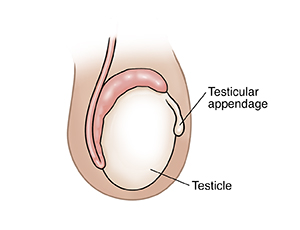
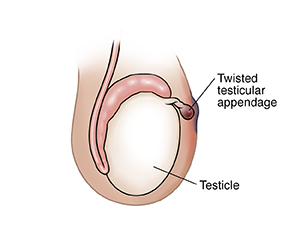
Testicular appendage torsion is the twisting of a small piece of tissue above a testicle. The appendage doesn’t have a function in the body. It can twist. This can cause pain and swelling that get worse over time. It is not the same as testicular torsion. It is not a medical emergency.
What causes testicular appendage torsion?
Testicular appendage torsion can happen at any time. It’s most likely to happen during sleep. When the appendage gets twisted, it cuts off its own blood supply. This doesn’t cause any serious damage. Children who haven’t yet reached puberty are most at risk.
Is it the same as testicular torsion?
Testicular appendage torsion is not the same thing as testicular torsion. Testicular torsion is the twisting of the testicle. It is a medical emergency. The torsion causes a loss of blood supply to the testicle. Surgery is needed right away to stop lasting (permanent) damage to the testicle. Torsion of the appendage does not cause any damage to the testicle. The symptoms can be similar in both conditions. But the pain of testicular torsion is often more severe.
Symptoms of testicular appendage torsion
Symptoms can include:
-
Pain in one testicle, on one side of the scrotum
-
Swelling and redness of the scrotum
-
Scrotum that’s sore to the touch
-
A hard lump at the top or bottom of the testicle
-
A blue dot at the top of the scrotum showing the twist is in the appendage, not the testicle
How is testicular appendage torsion diagnosed?
Your healthcare provider will ask about your child's health history and symptoms. Your child will be given a physical exam. Your child may also have tests such as:
-
Urine test to check for other possible causes of scrotal pain such as infection
-
Imaging test of the child's scrotum, such as ultrasound
In some cases, your child may need surgery right away if it seems your child may have testicular torsion. This is to help prevent severe problems. During surgery, the healthcare provider will be able to see if the condition is testicular appendage torsion.
Treatment for testicular appendage torsion
Treatment for testicular appendage torsion includes:
-
Rest
-
Raising the area to help ease swelling
-
Over-the-counter anti-inflammatory pain medicine
When to call the healthcare provider
Call the healthcare provider if your child’s symptoms don’t get better, or get worse.
Online Medical Reviewer: Dan Brennan MD
Online Medical Reviewer: Liora C Adler MD
Online Medical Reviewer: Raymond Kent Turley BSN MSN RN
Date Last Reviewed: 12/01/2022
© 2000-2025 The StayWell Company, LLC. All rights reserved. This information is not intended as a substitute for professional medical care. Always follow your healthcare professional's instructions.
Personalized Pediatric Care
San Juan Health Partners Pediatrics. Dedicated to caring for your children.
Find a Doctor
Personalized Services Just for You
San Juan Health Partners Urology. Compassionate care you can trust.
Find a Doctor
Call for an Appointment
Offering personalized care at more than 20 clinics across three cities and two states.
Call NowRelated Articles
Urinary Incontinence (Enuresis) in Children
When wetting happens in a child who is old enough to control their bladder, it’s known as enuresis. Here's what you need to know.
Disorders of Sex Development
When a child's gender is in question at birth, the child has atypical genitalia (ambiguous genitalia). This means that the genitals don't seem to be clearly male or female.
Male Bladder Infection (Child)
Read on for details about caring for a male child with a bladder infection.
When Your Child Has Vesicoureteral Reflux
Your child has been diagnosed with vesicoureteral reflux (VUR). This condition affects the urinary tract. VUR isn't painful. And it can be treated or managed. In some cases, children even outgrow the condition. Your child's health care provider will tell you more about choices for your child.