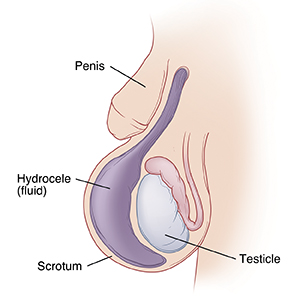
Hydrocele is a collection of fluid in the scrotum surrounding the testicle. This sometimes happens to baby boys.
This could happen because the baby’s abdominal wall wasn’t fully developed at birth. Or there may be an opening between the abdomen and scrotum that didn’t close as it should have after birth.
When is a hydrocele treated?
Hydrocele often goes away by itself, as the body slowly absorbs the abdominal fluid. But in some cases, surgery is needed. The hydrocele will be treated if:
-
The amount of fluid increases, making the scrotum large and firm.
-
The hydrocele becomes infected, painful, or uncomfortable.
-
The fluid isn’t absorbed within the baby’s first year of life.
-
The baby also has a loop of bowel (a hernia) extending into the same area.
What are the long-term effects?
After the hydrocele goes away or is treated, lasting problems are rare.
Signs of a problem
If you see any of these signs, contact your baby’s health care provider or get medical care right away:
-
The hydrocele gets bigger or red.
-
Your baby cries more than normal and can’t be soothed.
-
Your baby cries or fusses when you touch the hydrocele.
Online Medical Reviewer: Dan Brennan MD
Online Medical Reviewer: Lalitha Kadali
Online Medical Reviewer: Rita Sather RN
Date Last Reviewed: 03/01/2025
© 2000-2025 The StayWell Company, LLC. All rights reserved. This information is not intended as a substitute for professional medical care. Always follow your healthcare professional's instructions.
Personalized Services Just for You
San Juan Health Partners Urology. Compassionate care you can trust.
Find a Doctor
Call for an Appointment
Offering personalized care at more than 20 clinics across three cities and two states.
Call NowRelated Articles
Exstrophy of the Bladder and Epispadias in Children
Exstrophy of the bladder is when a baby's bladder has grown inside out and is sticking through the belly wall. It often occurs together with epispadias. This is when the opening of the tube that carries urine out of the body (the urethra) is in the wrong place.
Catheter-Linked Urinary Tract Infections
A catheter-associated urinary tract infection (CAUTI) is an infection of the urinary system. CAUTI is caused by germs that get into the urinary tract when a urinary catheter is used. This is a tube that's placed into the bladder to drain urine.
When Your Child Needs a Voiding Cystourethrogram (VCUG)
Learn what to expect before during, and after your child has a voiding cystourethrogram (VCUG). This test uses X-rays to show the flow of urine through the urinary tract. It lets the doctor see how your child's bladder functions.
Posterior Urethral Valves in Children
Posterior urethral valves are a problem with the urethra in a boy. The valves partly block urine flow because not enough urine can get through them to leave the body. This can harm the urethra, bladder, ureters, and kidneys.