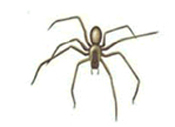
Brown recluse spiders are most often found in the South, West, and Midwest. They may be light or dark brown. They are ¼ inch to ¾ inch long, and have long, thin, legs. Some have a fiddle-shaped mark on their back. They prefer dark places and often live indoors in cupboards, basements, or attics. They also live outdoors under rocks or trash cans. These spiders only bite when disturbed.
When a brown recluse bites, a small red mark may form at the site. Then small blisters may appear. Within 2 to 8 hours, the area may become painful, swollen, and itchy. The child may develop a fever and be restless. Other possible symptoms include upset stomach (nausea), vomiting, and muscle pain. In most cases, the bite site heals on its own within a week. But in some cases, the skin at the bite site may break down and form an open wound (ulcer). An ulcer can take from a week to a few months to heal. In rare cases, a brown recluse bite may lead to more serious problems. These can include muscle damage, kidney failure, problems with blood clotting, and coma.
The doctor will clean the bite site and give medicines to relieve pain, if needed. Antibiotics may also be given to treat infection. A tetanus shot may be given. If an ulcer forms, skin grafting may be done later to repair severe damage to the skin. But most bites heal without scarring.
Home care
Medicines may be prescribed to relieve pain or treat infection. Follow directions for giving these medicines to your child.
General care
-
Let your child rest as needed.
-
Care for the bite site as directed by your child’s doctor.
-
To ease pain and swelling, apply cold packs to the bite site as directed. Use a cool wet washcloth or an ice pack. To make an ice pack, put ice cubes in a plastic bag that seals at the top. Then wrap the bag in a thin towel. Don’t put ice directly on the skin.
-
If your child was bitten in the arm or leg, it may help to keep the body part raised (elevated) to reduce swelling.
-
Check the bite site for any unusual changes or signs of infection (see below).
Prevention
-
Warn your child to stay away from woodpiles and other areas that attract spiders.
-
Catch spiders indoors by placing sticky tape on the floor.
-
Move your child’s bed away from the wall.
-
Teach your child to shake out clothes or blankets that have fallen onto the floor before using them.
-
Teach your child to shake out shoes before putting them on.
Follow-up care
Follow up with your child’s doctor, or as advised.
Poison Control
Call the Poison Help Line at 1-800-222-1222 if you have any immediate concerns. Or use webPOISONCONTROL® to get help online.
When to get medical care
Contact your child’s doctor right away if:
-
Your child has a fever of 100.4°F (38°C) or higher, or as advised by the doctor.
-
Your child's pain gets worse and is not relieved with medicine.
-
Your child has signs of infection at the bite site, such as more redness or streaking, swelling, or bad-smelling drainage.
-
The bite site becomes black or blue.
-
The bite site won’t heal or grows larger.
Online Medical Reviewer: Bass, Pat F III, MD, MPH
Online Medical Reviewer: Foster, Sara, RN, MPH
Date Last Reviewed: 05/01/2025
© 2000-2025 The StayWell Company, LLC. All rights reserved. This information is not intended as a substitute for professional medical care. Always follow your healthcare professional's instructions.
Personalized Pediatric Care
San Juan Health Partners Pediatrics. Dedicated to caring for your children.
Find a Doctor
Convenient Care When You Need It
San Juan Health Partners Urgent Care is here for you with walk-in care for life’s urgent matters.
Find Urgent Care
Call for an Appointment
Offering personalized care at more than 20 clinics across three cities and two states.
Call NowRelated Articles
Marine Bite or Sting
Learn how to care for yourself at home after a marine bite or sting.
Marine Bites and Stings
You're most likely to come in contact with biting or stinging marine life when you're swimming or wading. Learn how to get care if that occurs.
Open Finger Fracture (Child)
A finger fracture is a broken finger bone. With an open fracture, a broken bone is exposed by a break in the skin. Because of this, there is a risk of infection to the skin or bone. Learn how to care for your child's open finger fracture at home.
Cervical Adenitis, Antibiotic Treatment (Child)
Bacterial cervical adenitis is an infection and swelling of lymph nodes in the neck. Symptoms include a swollen neck that is tender and painful to the touch.