Your child has been diagnosed with Sever disease. This is an irritation of the area where the Achilles tendon attaches to the heel (calcaneus). Constant pulling on the Achilles tendon causes the area to become inflamed. This condition is painful. But with correct care, it can be treated.
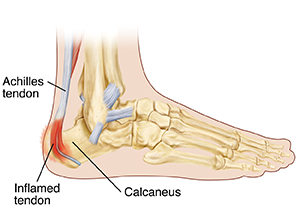
What causes Sever disease?
Activities that require a lot of running and jumping cause the Achilles tendon to pull on the heel. This can lead to soreness and pain. Sports, such as basketball and soccer, put players at risk of Sever disease.
What are the symptoms of Sever disease?
Symptoms often appear at the beginning of a sports season. This is because the tendons and muscles aren’t ready for the stress of running and jumping. Symptoms include:
-
Heel pain with activity
-
Heel pain after activity
-
Limping
How is Sever disease diagnosed?
The healthcare provider will ask about your child's health history and examine your child. During the exam, the healthcare provider checks your child's heel for tenderness and pain. An X-ray may also be taken to evaluate the heel bone and rule out other problems.
How is Sever disease treated?
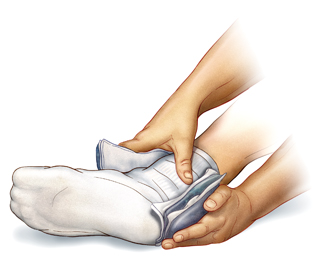
The healthcare provider will talk with you about the best treatment plan for your child. As instructed, your child will:
-
Ice the heel
3 to 4 times a day for15 to 20 minutes at a time. To make an ice pack, put ice cubes in a plastic bag that seals at the top. Wrap the bag in a clean, thin towel or cloth. Never put ice directly on your child's skin. -
Take anti-inflammatory medicine, such as ibuprofen, as directed.
-
Decrease the amount physical activity, such as running and jumping, your child does until there is no discomfort or significant pain afterwards. This may need several months in some cases.
-
Stretch the heels and calves, as instructed by the healthcare provider. Regular stretching can help prevent Sever disease from coming back.
-
Use a “heel cup” or a cushioned shoe insert that takes pressure off the heel.
In some cases, a walking boot may be needed to immobilize the foot while it heals.
What are the long-term concerns?
With correct treatment, the injury should heal without any long-term concerns. Sever disease may happen once again when the child increases sports activities, but rarely recurs once the child is fully grown.
Featured in
Online Medical Reviewer: Rahul Banerjee MD
Online Medical Reviewer: Raymond Turley Jr PA-C
Online Medical Reviewer: Rita Sather RN
Date Last Reviewed: 04/01/2024
© 2000-2025 The StayWell Company, LLC. All rights reserved. This information is not intended as a substitute for professional medical care. Always follow your healthcare professional's instructions.
Personalized Pediatric Care
San Juan Health Partners Pediatrics. Dedicated to caring for your children.
Find a Doctor
Convenient Care When You Need It
San Juan Health Partners Urgent Care is here for you with walk-in care for life’s urgent matters.
Find Urgent Care
Call for an Appointment
Offering personalized care at more than 20 clinics across three cities and two states.
Call NowRelated Articles
When Your Child Stays in the Hospital
The hospital can seem like a large and scary place to your child. This sheet can help you learn what goes on during a hospital stay, so you can know what to expect and ease some of your child's fears.
When Your Child Is in the Intensive Care Unit
I your child is in the ICU, it means that they need special care and attention that can be given only by a team of specially trained healthcare providers. This sheet tells you more about what to expect when your child is in the ICU.
Oral Candida Infection (Thrush) in Your Child
Thrush is a yeast infection that affects the mouth. Babies with thrush are often fussy and may have trouble feeding. Thrush is seldom serious in healthy children and adults.
Child Vaccine Schedule
This list of childhood vaccines and when to give them is based on CDC recommendations.