Medicines are not the only way to ease pain after surgery. Try these methods instead of pain medicine or to lower the amount of pain medicine you need.
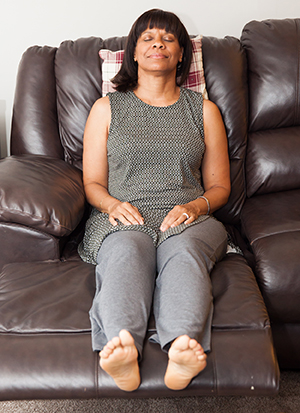
Visualization or guided imagery
Visualization helps take your mind off the pain:
-
Close your eyes. Breathe deeply.
-
Picture yourself in a quiet, peaceful place.
-
Imagine how you feel in that place.
-
If other thoughts come into your mind, take a deep breath and try again.
Progressive body relaxation
Relaxation helps ease stress and pain:
-
Close your eyes. Clench your foot muscles.
-
Hold for a few seconds. Release.
-
Repeat with the muscles in your calves.
-
Work slowly up your body. Tense and relax different muscle groups from your belly, chest, arms, neck, and face.
Deep breathing
Deep breathing relaxes your whole body:
-
Inhale through your nose slowly and deeply.
-
Hold your breath for a few seconds.
-
Exhale through your mouth slowly and deeply.
-
Repeat 3 more times.
Online Medical Reviewer: Jonas DeMuro MD
Online Medical Reviewer: Raymond Turley Jr PA-C
Online Medical Reviewer: Tara Novick BSN MSN
Date Last Reviewed: 02/01/2025
© 2000-2025 The StayWell Company, LLC. All rights reserved. This information is not intended as a substitute for professional medical care. Always follow your healthcare professional's instructions.
Expert Surgical Care
San Juan Health Partners General Surgery. Providing personalized treatment options for you.
Learn More
Call for an Appointment
Offering personalized care at more than 20 clinics across three cities and two states.
Call NowRelated Articles
Having Male-to-Female Breast Augmentation
Male-to-female breast augmentation is done to give a person a more female-looking chest. A plastic surgeon increases breast size, often with implants.
Post-Surgery Checklist
After surgery, there are steps you can take to help with your recovery. You may have been an inpatient (staying in the hospital overnight) or an outpatient (going home the day of surgery). While in the hospital, it is important to follow directions from your surgeon, nurse, and other health care providers.
Discharge Instructions: Caring for Your Jackson-Pratt Drainage Tube
Doctors commonly leave this drain within the abdominal cavity after surgery. It helps prevent swelling and reduces the risk for infection. The tube is held in place by a few stitches. It is covered with a bandage. Your doctor will remove the drain when he or she determines you no longer need it.
Caring for a Closed Suction Drainage Tube
A drainage tube removes fluid from around an incision. This helps prevent infection and promotes healing. Follow these instructions.