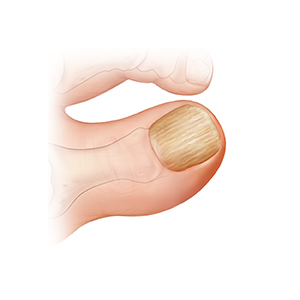
Several things can cause very thickened nails. They can be caused by injuries or pressure from shoes. Fungal infections are a common cause. Diabetes, psoriasis, or vascular disease are other possible causes.
Symptoms of thickened nails
Along with thickening, the nail may have ridges, be brittle, or look yellowish. It may hurt when pressure is put on it. After a while, a thickened nail may get loose and fall off.
Assessment of thickened nails
Thickened nails may be a symptom of a medical condition. Because of this, your health care provider will look at your health history. The thickness and color of the nail are checked carefully. This helps to find the cause. A test may be done to check for fungal infection.
Treatment of thickened nails
-
For infection. Oral or topical antifungal medicines may be used to treat infection. These can help prevent sores under the nail. They also keep the fungus from spreading to other nails.
-
For thick nails not caused by infection. Thinning the nail may be an option. This can be done by trimming, filing, or grinding.
-
For pain. If the nail causes pain, part or all of the nail can be removed with surgery. Never try to remove a nail by yourself.
Preventing thickened nails
You can prevent many nail problems by wearing the right shoes and trimming your nails correctly. Keep your feet clean and dry to help prevent infection. If you have diabetes, talk with your health care provider before doing any foot self-care.
-
The right shoes. Get your feet measured. Your size may change as you age. This is due to ligaments that get loose with age and allow the bones in your foot to change position or spread. Wear shoes that are supportive and roomy enough for your toes to wiggle. Look for shoes made of natural materials, such as leather, which lets air get to the skin on your feet.
-
Correct trimming. To prevent problems, trim your toenails straight across. Then file the edges with a nail file. If you can’t trim your own nails, ask your provider to do it for you.
Online Medical Reviewer: Raymond Turley Jr PA-C
Online Medical Reviewer: Stacey Wojcik MBA BSN RN
Online Medical Reviewer: Thomas N Joseph MD
Date Last Reviewed: 02/01/2025
© 2000-2025 The StayWell Company, LLC. All rights reserved. This information is not intended as a substitute for professional medical care. Always follow your healthcare professional's instructions.
Find the right provider to meet your needs
From primary care to specialty services and more.
Find a Doctor
Call for an Appointment
Offering personalized care at more than 20 clinics across three cities and two states.
Call NowRelated Articles
Ringworm of the Scalp
Ringworm is caused by a fungus, not a worm. It's passed from animals or people infected with the fungus. Here's what you need to know about caring for yourself at home.
Pyogenic Granuloma
Pyogenic granuloma is an overgrowth of skin in response to an injury, or hormones, or certain drugs. Here's what you need to know about caring for yourself at home.
Understanding Hidradenitis Suppurativa
Hidradenitis suppurativa is a long-term (chronic) skin disease. It causes painful bumps and sores to form around a hair follicle.
Athlete’s Foot
Athlete's foot is caused by a fungal infection in the skin. It affects the skin between the toes, causing fissures (cracks in the skin). It can also affect the bottom of the foot where it causes dry white scales and peeling of the skin. Learn about caring for this condition.