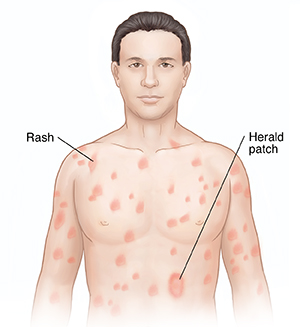
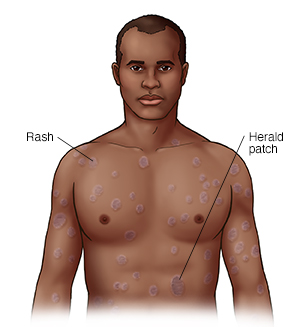
Pityriasis rosea means rose-colored rash. It is a type of skin rash. It starts with one large round or oval scaly patch called a herald patch or a mother patch. And then it causes many more small patches. The rash most often appears on the chest, back, and belly. It can take 2 to 3 months to go away.
How to say it
piht-tah-RI-uh-sihs ROH-zee-ah
What causes pityriasis rosea?
The cause is not yet known but experts think it may be from a virus.
The rash happens most often in people ages 10 to 35, and during pregnancy. If you're pregnant, make sure to tell your doctor about your rash.
The rash can also be caused by certain medicines. Some forms of syphilis may look a lot like pityriasis rosea. If your doctor isn't sure, you may have blood tests done. Or you may need to test a sample of the rash (skin biopsy.)
Symptoms of pityriasis rosea
In some people, the rash shows up 1 to 2 weeks after symptoms, such as headache, sore throat, upset stomach (nausea), stuffy nose, fatigue, body ache, and fever. The rash often starts with one large scaly patch in the shape of a circle or oval. The patch may be pink or red if you have pale skin. It may be purple, brown, or gray if you have darker skin. It can be 1 to 2 inches wide or larger. It often appears on the chest or back. This is called a herald or mother patch.
Smaller scaly spots then show up in 1 to 2 weeks on the chest, back, belly, arms, and legs. It can also show up on the neck and face. The rash can form the shape of a Christmas tree on your back. The rash may itch, especially if your skin gets warmer during exercise or a hot shower. You may also feel tired and achy.
Treatment for pityriasis rosea
The rash should go away without treatment. But it can take 4 to 8 weeks or longer.
You can treat your itching with any of these:
-
Corticosteroid cream or ointment. You can apply this medicine to the rash 2 to 3 times a day, for 2 to 3 weeks.
-
Calamine lotion. This is a pink, watery lotion that can help stop itching.
-
Antihistamine. This medicine can help with itching. But it may also make you drowsy. Don't drive or operate heavy machinery when you are taking this medicine. Ask your doctor about a nondrowsy form of this medicine.
-
Other anti-itch lotion or cream. Do not use over-the-counter lotions or creams without talking to your doctor first. Some lotions and creams may cause more harm than good. Always ask your doctor about other anti-itch lotions or creams that can help ease itching. Your doctor may prescribe a stronger medicine if over-the-counter medicine isn’t helping you.
If you have severe symptoms, your doctor may treat you with:
-
Acyclovir. This is a type of antivirus medicine. It may help the rash go away sooner in some people.
-
Ultraviolet B light treatment. Exposing the skin to ultraviolet light in the first week can help reduce symptoms. These treatments are given at your doctor's office.
When to contact your doctor
Contact your doctor or get medical care right away if you have:
-
New symptoms.
-
A rash that lasts for more than 3 months.
-
Symptoms that don’t get better in 1 to 2 months, or get worse.
Author: Wheeler, Brooke
Online Medical Reviewer: Michael Lehrer MD
Online Medical Reviewer: Raymond Kent Turley BSN MSN RN
Online Medical Reviewer: Tennille Dozier RN BSN RDMS
Date Last Reviewed: 05/01/2025
© 2000-2025 The StayWell Company, LLC. All rights reserved. This information is not intended as a substitute for professional medical care. Always follow your healthcare professional's instructions.
Find the right provider to meet your needs
From primary care to specialty services and more.
Find a Doctor
Call for an Appointment
Offering personalized care at more than 20 clinics across three cities and two states.
Call NowRelated Articles
Candida Skin Infection (Adult)
Candida is a type of yeast that grows naturally on the skin and in the mouth, but it can grow out of control and cause an infection. Here's how to care for yourself at home if you have this infection.
Facial Bruise (Contusion)
A facial contusion can cause swelling, pain, and changes in skin color.
Understanding Epidermoid Cyst
An epidermoid cyst is a small abnormal growth in the top layers of the skin. These cysts grow slowly, and they can grow anywhere on the body. Learn about causes, symptoms, and treatment.
Molluscum Contagiosum (Adult)
Molluscum contagiosum is a common skin infection that is caused by a pox virus, results in raised, flesh-colored bumps on the skin.