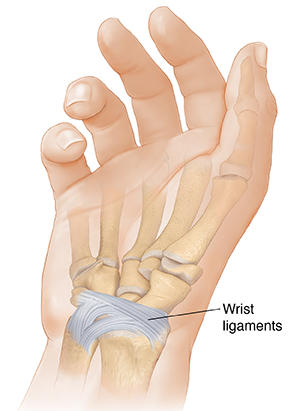
A ligament is a strong band of tissue that connects bone to bone. The wrist has many ligaments. If any of these get stretched or torn, this is called a wrist sprain. A wrist sprain can be painful. It can also limit movement and use of the wrist and hand. Depending on the severity of the sprain, it may take a few weeks or longer for the wrist to heal.
Causes of a wrist sprain
Wrist sprains are most often caused by falling and landing on an outstretched hand. Anyone can get a wrist sprain. But the injury may be more likely in people who are very active or play sports.
Symptoms of a wrist sprain
At the time of injury, you may feel a popping or tearing in the wrist. You may have pain, redness, and swelling. You may also have some bruising. In some cases, symptoms may spread from the wrist to the hand. Until the wrist has healed, it may be hard to move or use the wrist and hand for normal tasks and activities, especially gripping and lifting.
Treating a wrist sprain
Treatment for wrist sprains may include any of the following:
-
Prescription or over-the-counter medicines. These help reduce pain and swelling. You may take these medicines as pills. Or you may apply them to the skin as a gel, cream, or patch. Nonsteroidal anti-inflammatory drugs are the most common medicines used.
-
A splint, brace, or cast. This is worn to support the wrist and keep the wrist from moving. You may need it for several weeks or longer, until the wrist heals.
-
Physical therapy and exercises. These help improve strength, flexibility, and range of motion in the wrist and hand.
-
Surgery. You may need surgery if the sprain is bad. For example, surgery may be needed if the ligament is torn or if nearby tissues and bone are also injured. After surgery, you will often need to wear a splint or cast for a month or longer, until the wrist has healed.
Self-care measures
You can do several things to help relieve pain and swelling. These may include:
-
Limiting how much you move and use your wrist and hand.
-
Applying an ice pack to the injured area. Wrap the ice pack in a clean, thin towel or cloth. Never put ice or an ice pack directly on the skin.
-
Keeping your wrist and hand raised (elevated) above heart level.
-
Wrapping your wrist in an elastic bandage.
Possible complications
If the injury doesn’t heal correctly, it has a higher chance of happening again. The injury can also become long-term (chronic). This can cause ongoing pain, weakness, or instability of the wrist. Over time, arthritis may develop in the wrist. This can make pain worse and cause stiffness and limited movement of the wrist and hand.
When to contact your doctor
Contact your health care provider right away if:
-
You have a fever of 100.4°F (38°C) or higher, or as directed by your provider.
-
You have chills.
-
Your symptoms don’t get better with treatment, or get worse.
-
Your hand or fingers feel numb or very cold, turn blue or gray, or swell.
-
You have symptoms, such as redness, warmth, swelling, bleeding, or drainage that occur at the incision sites. This only applies if you had surgery.
-
You have new symptoms.
Author: Yang, Sue
Online Medical Reviewer: Raymond Turley Jr PA-C
Online Medical Reviewer: Stacey Wojcik MBA BSN RN
Online Medical Reviewer: Thomas N Joseph MD
Date Last Reviewed: 04/01/2025
© 2000-2025 The StayWell Company, LLC. All rights reserved. This information is not intended as a substitute for professional medical care. Always follow your healthcare professional's instructions.
Find the right provider to meet your needs
From primary care to specialty services and more.
Find a Doctor
Call for an Appointment
Offering personalized care at more than 20 clinics across three cities and two states.
Call NowRelated Articles
Understanding Prepatellar Bursitis
The prepatellar bursa is found on top of the kneecap (patella). It lies just under the skin. If this bursa becomes irritated and inflamed, the condition is called prepatellar bursitis. Read on to learn more including causes, symptoms, diagnosis, and treatment.
Leg Cramps
A muscle cramp or spasm is a strong contraction of the muscle fibers.
Quadriceps Tendon Rupture
A quadriceps tendon rupture is often a sports-related injury. It may occur after landing very hard from a high jump, or after suddenly changing direction when running fast.
Coccyx or Sacrum Bruise (Contusion)
A contusion of the coccyx or sacrum causes swelling and some bleeding under the skin. This injury generally takes a few weeks to heal. Read on for details about how to care for yourself.