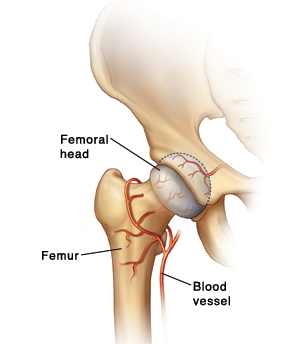
Legg-Calve-Perthes disease happens when the ball of the thighbone in the hip doesn’t get enough blood. This causes the bone to die. As a result, the bone may break easily, even without a major injury. These breaks take a long time to heal. The disease is also known as avascular necrosis of the hip. The cause of this disease is not known. It generally happens between ages 4 and 10. It most often affects boys.
The earliest sign of the disease is limping. There may also be pain or stiffness in the hip. One leg may be shorter than the other.
The earlier the disease is found, the better the outcome. However, if the problem develops after age 8, there may be long-term effects. These include deformity of the hip joint and osteoarthritis as an adult.
Your child’s treatment will vary based on the severity of the disease. The goals of treatment are to relieve symptoms, maintain hip motion, and keep the hip in the correct position. Treatment may include any of the following:
-
Over-the-counter pain medicines
-
Physical therapy
-
Crutches
-
Cast or brace
-
Surgery
Most children with the disease can return to normal activities within 2 years of treatment.
Home care
-
Limit activity as advised by your child’s health care provider. Initially, it's generally advised to not put weight on the affected leg.
-
You may use over-the-counter pain medicine to control pain, unless another medicine was prescribed. If your child has chronic liver or kidney disease or has ever had a stomach ulcer or gastrointestinal bleeding, talk with your health care provider before using these medicines.
Follow-up care
Follow up with your child's health care provider, or as advised.
When to get medical advice
Contact your child's health care provider if either of the following occur:
-
Sudden increase in hip pain with or without injury
-
Increased limping
Online Medical Reviewer: Rahul Banerjee MD
Online Medical Reviewer: Raymond Turley Jr PA-C
Online Medical Reviewer: Stacey Wojcik MBA BSN RN
Date Last Reviewed: 01/01/2025
© 2000-2025 The StayWell Company, LLC. All rights reserved. This information is not intended as a substitute for professional medical care. Always follow your healthcare professional's instructions.
Find the right provider to meet your needs
From primary care to specialty services and more.
Find a Doctor
Call for an Appointment
Offering personalized care at more than 20 clinics across three cities and two states.
Call NowRelated Articles
Shoulder Bruise
You have a shoulder injury called a contusion (bruise). This causes pain, swelling, and sometimes bruising on the skin.
Possible Wrist Fracture
You are very sore over a bone in your wrist. This could be a sign of a hairline fracture, or break, even though no fracture was seen on the X-ray. Read on to learn how to care for yourself at home.
When Your Child Has Jumper’s Knee
Your child has been diagnosed with a condition called jumper’s knee. This is an irritation of the patellar tendon, which connects the kneecap (patella) to the shinbone (tibia). Your child will have some pain. But the pain should go away with correct care. Learn details about that here.
Understanding Dupuytren Contracture
Dupuytren contracture is a disease that can lead to limited use of your hand. While it often doesn't cause pain, it can make it hard to straighten your fingers. Learn about causes, symptoms, and treatment.