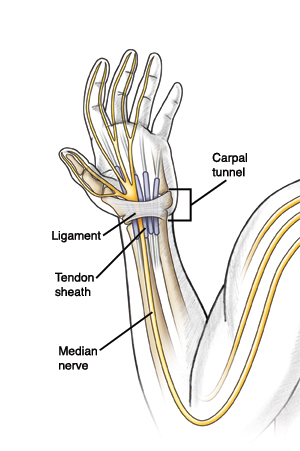
Carpal tunnel syndrome is a painful condition of the wrist and hand. It is caused by pressure on the median nerve. The median nerve is one of the nerves that give feeling and movement to the hand. It passes through a tunnel in the wrist called the carpal tunnel. This tunnel is made up of bones and ligaments. Narrowing of this tunnel or swelling of the tissues inside the tunnel puts pressure on the median nerve and the tiny blood vessels that bring oxygen to the nerve. This causes numbness, pins and needles, or electric shooting pains in your hand and forearm. Often the pain is worse at night. It may wake you when you sleep.
Carpal tunnel syndrome may occur during pregnancy and with the use of birth control pills. It's more common in workers who must often bend their wrists. It's also common in people who work with power tools that cause strong vibrations. Other people who are more likely to have this include people with diabetes, people who are overweight, and those who smoke.
Home care
-
Rest the painful wrist. Don't bend your wrist back and forth repeatedly. This puts pressure on the median nerve. Don't use power tools with strong vibrations.
-
If you smoke, try to quit.
-
If you have diabetes, make sure your condition is under control.
-
If you were given a splint, wear it at night while you sleep. You may also wear it during the day for comfort.
-
Move your fingers and wrists often to prevent stiffness.
-
Prop up your arms on pillows when you lie down.
-
Try using the unaffected hand more.
-
Try not to hold your wrists in a bent, downward position.
-
Sometimes changes in the workplace may ease symptoms. If you type most of the day, try changing the position of your keyboard or adding a wrist support. Your wrist should be in a neutral position and not bent back when you type.
-
You may use over-the-counter pain medicine to treat pain and inflammation, unless another medicine was prescribed. Anti-inflammatory pain medicines, such as ibuprofen or naproxen, may work better than acetaminophen, which treats pain but not inflammation. If you have chronic liver or kidney disease or ever had a stomach ulcer or gastrointestinal bleeding, talk with your health care provider before using these medicines.
-
Opioid pain medicine will give only short-term (temporary) relief. It doesn't treat the problem. If pain continues, an injection of steroid medicine into the wrist area may help.
-
If the above methods fail, you may need surgery. This will open the carpal tunnel and release the pressure on the trapped nerve.
-
Low-level laser therapy has no proven benefit for carpal tunnel syndrome.
Follow-up care
Follow up with your health care provider, or as advised. If X-rays were taken, you'll be told of any new findings that may affect your care.
When to get medical advice
Contact your health care provider or seek medical care right away if:
-
Your pain doesn't improve with the above treatment.
-
Your fingers or hand become cold, blue, numb, or tingly.
-
Your whole arm becomes swollen or weak.
Online Medical Reviewer: Esther Adler
Online Medical Reviewer: Luc Jasmin MD
Online Medical Reviewer: Rita Sather RN
Date Last Reviewed: 02/01/2025
© 2000-2025 The StayWell Company, LLC. All rights reserved. This information is not intended as a substitute for professional medical care. Always follow your healthcare professional's instructions.
Find the right provider to meet your needs
From primary care to specialty services and more.
Find a Doctor
Call for an Appointment
Offering personalized care at more than 20 clinics across three cities and two states.
Call NowRelated Articles
Sacroiliitis
Sacroiliitis is when one or both sacroiliac joints are hurt or inflamed. It can make small movements of the lower back and pelvis very painful. Learn how to care for yourself at home.
Understanding a Clavicle Fracture
A fracture of the clavicle is a broken collarbone. Clavicle fractures occur most often along the middle of the bone. Depending on how badly the bone is broken, healing may take a few months or longer.
Thoracic Spine Strain
Learn how to care for a thoracic spine strain.
De Quervain Tenosynovitis
De Quervain tenosynovitis is inflammation of tendons and synovium on the thumb side of the wrist. Learn how to care for this condition at home.