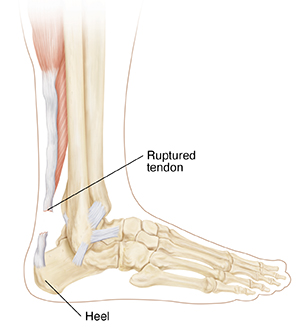
Your Achilles tendon is a large band of tissue in the back of your ankle. It connects your calf muscles to your heel bone. The tendon helps you point your foot down, rise on your toes, and push off when you walk. You use it almost each time you move your leg. But repeated stress can make the tendon more prone to injury. It may become inflamed and develop small tears (tendonitis). A complete tear through the tendon is called an Achilles tendon rupture.
When to go to the emergency room (ER)
Get medical care right away if you:
-
Hear a loud pop or snapping sound
-
Have the feeling of being hit hard in the back of the leg
-
Are not able to stand on your toes, bend your foot downward, or walk normally
A ruptured Achilles tendon may not cause a lot of pain. So if you hear a loud pop, get medical care. Do this even if you can walk and don`t have pain.
What to expect in the ER
A healthcare provider will examine your feet, ankles, and legs. They are likely to ask about your physical activities. You may tests. These could include an MRI scan. This detailed imaging test uses magnets and a computer to make a clear picture of the tendons. An ultrasound may also be done. Ultrasound uses sound waves to create an image of the injured area.
Your treatment
If your tendon has ruptured, you will be referred to an orthopedic surgeon or a primary care sports healthcare provider. They will discuss your treatment choices with you. These include surgery to fix the tendon. Or wearing a cast or boot and using crutches until the tendon heals.
Online Medical Reviewer: L Renee Watson MSN RN
Online Medical Reviewer: Raymond Turley Jr PA-C
Online Medical Reviewer: Thomas N Joseph MD
Date Last Reviewed: 04/01/2024
© 2000-2025 The StayWell Company, LLC. All rights reserved. This information is not intended as a substitute for professional medical care. Always follow your healthcare professional's instructions.
Find the right provider to meet your needs
From primary care to specialty services and more.
Find a Doctor
Call for an Appointment
Offering personalized care at more than 20 clinics across three cities and two states.
Call NowRelated Articles
Rib Contusion or Minor Fracture
A rib fracture (bone break) may cause the same symptoms as a rib contusion. Treatment for both is the same.
Understanding a Clavicle Fracture
A fracture of the clavicle is a broken collarbone. Clavicle fractures occur most often along the middle of the bone. Depending on how badly the bone is broken, healing may take a few months or longer.
Torticollis
Torticollis is a condition in which the neck is twisted and causes the head to rotate and tilt at an odd angle. The cause of torticollis is unknown, but treatment can help.
Radial Head Subluxation (Pulled Elbow, Nursemaid's Elbow)
Soft tissue may become trapped between the bones in a child's elbow joint (radial head subluxation). It often happens when a child is lifted or pulled by one arm.