Casting the fracture
To make sure the bone is lined up the right way, an X-ray is taken. Then the ankle is put in a cast to hold the bone in place during healing. You’ll likely have to wear the cast for several weeks. For less severe fractures, a walking boot, brace, or splint may be all that’s needed to hold the bone in place during healing.
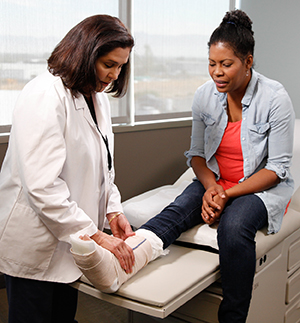
Closed reduction
If you have a clean break with little soft tissue damage, closed reduction may be used. This means that no cuts (incisions) are made in the skin. Before the procedure, you may be given medicine to relax your muscles. Then your healthcare provider manually readjusts the position of the broken bone.
Open reduction
Open reduction and internal fixation is a surgical procedure which may be needed for displaced fractures, fractures that involve the joint, or open fractures. (An open fracture is one in which the bone has poked through the skin.) Your surgeon makes one or more cuts (incisions) to realign the bone and fix soft tissue. You will be given medicine during the procedure to let you sleep and relax your muscles. Screws or plates may be used to hold the bone in place during healing.
The road to healing
Once your fracture has been treated, your healthcare provider will tell you how to help it heal. You may be told to limit ankle use or weight-bearing activities. You may have to take medicines and elevate the foot. If you have a cast, remember to keep it dry.
Online Medical Reviewer: Rahul Banerjee MD
Online Medical Reviewer: Ronald Karlin MD
Online Medical Reviewer: Stacey Wojcik MBA BSN RN
Date Last Reviewed: 08/01/2023
© 2000-2025 The StayWell Company, LLC. All rights reserved. This information is not intended as a substitute for professional medical care. Always follow your healthcare professional's instructions.
Find the right provider to meet your needs
From primary care to specialty services and more.
Find a Doctor
Call for an Appointment
Offering personalized care at more than 20 clinics across three cities and two states.
Call NowRelated Articles
Treatment for Bone Bruise (Bone Contusion)
A bone bruise is an injury to a bone that is less severe than a bone fracture. Bone bruises are fairly common. They can happen to people of all ages.
Kneecap Surgery: Removing Damaged Cartilage
Surgery may be used when pain severely limits your activities. Or it may be done when a rehab program or other nonsurgical treatments just are not helping enough. Some procedures may be done using arthroscopy. This method uses tiny incisions and special instruments to look and work inside the knee joint. Other procedures need open surgery.
Before Arthroscopy
Here's what to know before you have arthroscopy.
Foot Surgery: Curled Fifth Toe
A curled fifth toe is most often inherited. When the fifth toe curls inward, it moves under the next toe. Then the nail of the curled toe starts to face outward. As a result, you may bear weight on the side of your toe instead of the bottom. This can cause corns and painful nails. There are many nonsurgical treatments available. But if these are not effective, surgery is a choice.