Kyphoplasty is a procedure that can help relieve the pain of vertebral compression fractures. This is a collapse of bone in your spine. It's most often caused by osteoporosis. Kyphoplasty is done to strengthen your spine (vertebrae) with special surgical cement. The procedure usually takes
Preparing for the procedure
Tell your health care provider about all medicines you take. This includes over-the-counter medicines, herbs, vitamins, and other supplements.
-
Ask your provider if you should stop taking any medicines, such as blood thinners, before the procedure.
-
Follow any directions you are given for not eating or drinking before surgery.
-
Arrange for an adult family member or friend to drive you home.
During the procedure
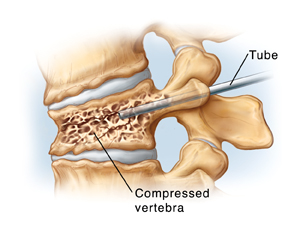
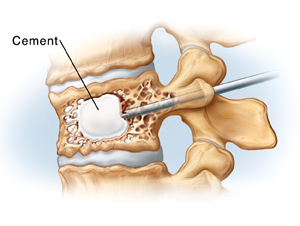
Your health care provider will give you anesthesia. This is medicine to keep you from feeling pain during the procedure.
-
Your surgeon makes one or more tiny incisions in your back.
-
Using live video X-ray images (fluoroscopy) as a guide, your surgeon inserts a hollow tube through the incision (cut) into the collapsed vertebra.
-
A small balloon is passed through the tube into the vertebra. There, it's inflated to open a space.
-
In most cases, the balloon is then removed, and the empty space is filled with special cement for bones.
Risks and possible complications
Kyphoplasty is considered safe. If complications do happen, they may include:
-
Spinal cord or nerve damage.
-
Cement leakage in blood vessels, or against the spinal cord.
-
Heart or lung problems.
-
New or unrelieved back pain.
-
Infection.
-
Allergy to the cement. (This is rare.)
-
Fractures of the nearby vertebrae.
After the procedure
You will be sent to a recovery room after the procedure. You probably will go home later the same day. Or you might stay the night in a hospital room. When you’re ready to go home, your health care provider will tell you how to care for yourself.
When to call your doctor
Contact your health care provider right away if you have:
-
A fever of
100.4 ° F (38.0 °C) or higher, or as directed by your doctor. -
New pain, weakness, tingling, or numbness in your legs.
-
New or unrelieved back pain.
Featured in
Online Medical Reviewer: Esther Adler
Online Medical Reviewer: Marianne Fraser MSN RN
Online Medical Reviewer: Shaziya Allarakha MD
Date Last Reviewed: 01/01/2025
© 2000-2025 The StayWell Company, LLC. All rights reserved. This information is not intended as a substitute for professional medical care. Always follow your healthcare professional's instructions.
Find the right provider to meet your needs
From primary care to specialty services and more.
Find a Doctor
Call for an Appointment
Offering personalized care at more than 20 clinics across three cities and two states.
Call NowRelated Articles
Confirmed Scaphoid Wrist Fracture
A scaphoid fracture is a fracture in one of the small bones of the wrist. This bone heals slowly. Some scaphoid fractures don't heal correctly, and may need surgery.
Finger Dislocation
How to care for your finger after a dislocation.
Foot Surgery: Surgical Settings
Your healthcare provider can tell you where your surgery will be done. You will also be told the type of anesthesia you’ll be given during surgery to stay pain-free during the procedure.
Discharge Instructions for Foot Surgery
Arrange to have an adult drive you home after surgery. If you had general anesthesia, it may take a day or more to fully recover. So, for at least the next 24 hours: Do not drive or use machinery or power tools; do not drink alcohol; and do not make any major decisions.