A healthy spine supports the body while letting it move freely. It does this with the help of three natural curves. Strong, flexible muscles help, too. They support the spine by keeping its curves correctly aligned. The disks that cushion the bones of your spine also play a role in back fitness.
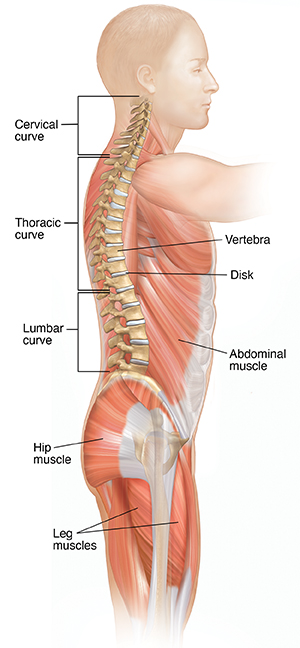
Three natural curves
The spine is made of bones (vertebrae) and pads of soft tissue (disks). These parts are arranged in three curves: cervical, thoracic, and lumbar. When correctly aligned, these curves keep your body balanced. They also support your body when you move. By distributing your weight throughout your spine, the curves make back injuries less likely.
Strong, flexible muscles
Strong, flexible back muscles help support the three curves of the spine. They do so by holding the vertebrae and disks in correct alignment. Strong, flexible abdominal, hip, and leg muscles also reduce strain on the back.
The lumbar curve
The lumbar curve is the hardest-working part of the spine. It carries more weight and moves the most. Aligning this curve helps prevent damage to vertebrae, disks, and other parts of the spine.
Cushioning disks
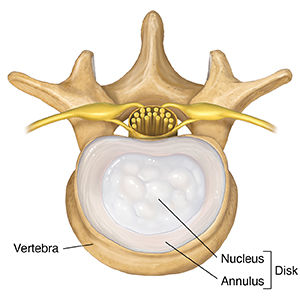
Disks are the soft pads of tissue between the vertebrae. The disks absorb shock caused by movement. Each disk has a spongy center (nucleus) and a tougher outer ring (annulus). Movement within the nucleus allows the vertebrae to rock back and forth on the disks. This provides the flexibility needed to bend and move.
Online Medical Reviewer: Louise Cunningham RN BSN
Online Medical Reviewer: Raymond Turley Jr PA-C
Online Medical Reviewer: Thomas N Joseph MD
Date Last Reviewed: 07/01/2024
© 2000-2025 The StayWell Company, LLC. All rights reserved. This information is not intended as a substitute for professional medical care. Always follow your healthcare professional's instructions.
Find the right provider to meet your needs
From primary care to specialty services and more.
Find a Doctor
Call for an Appointment
Offering personalized care at more than 20 clinics across three cities and two states.
Call NowRelated Articles
Carpal Tunnel Syndrome Prevention Tips
Certain repetitive hand activities may put you at higher risk for developing carpal tunnel syndrome. Learning how to modify the use of your hands can help you reduce the risk.
Preventing Repetitive Motion Injury: Shoulder
Making changes in how you use your shoulder can reduce your chances of repetitive motion injuries (RMIs).
Headache After Spinal Tap (No Patch)
If there is a loss of too much spinal fluid from a leak at the puncture site after a spinal tap, the spinal fluid pressure goes down and a headache occurs. This headache may be mild or severe. There may also be dizziness, nausea and blurred vision. Here's what you need to know.
Paresthesia
Paresthesia is a burning or prickling feeling that's sometimes felt in the hands, arms, legs or feet. It can also occur in other parts of the body. Learn details about home care after seeing your health care provider.