The ball of your foot is the bottom part just behind your toes. Bands of tissue (ligaments) connect the bones in the ball of your foot. Nerves run between the bones and underneath the ligaments. When a nerve or a number of small nerves become pinched, this causes them to swell and become painful because of the thickening of the tissue that surrounds the nerves. The painful, swollen nerve or cluster of nerves is called a neuroma (also called Morton neuroma).
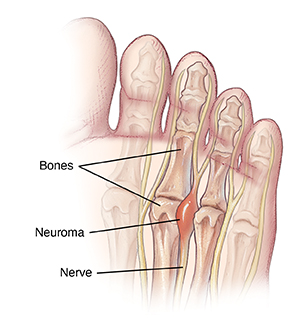
What causes a neuroma?
Runners often report this problem and describe pain as they push off from the starting block. Wearing tight or high-heeled shoes can cause a neuroma. Shoes that are too narrow or too pointed squeeze the bones in the ball of the foot. Shoes with high heels put extra pressure on the ends of the bones. When the bones are squeezed together, they pinch the nerve that runs between them.
Symptoms
The most common symptom of a neuroma is pain in the ball of the foot between two toes. The pain may be dull or sharp. It may feel as if you have a stone in your shoe. You may also have tingling or numbness in one or both of the toes. Symptoms may happen after you have been walking or standing for a while. Taking off your shoes and rubbing the ball of your foot may decrease or relieve the pain.
Preventing future problems
To prevent a future neuroma, buy shoes with plenty of room across the ball of the foot and in the toes. This keeps the bones from being squeezed together. Wearing low-heeled shoes (less than 2 inches) also puts less pressure on the bones and nerves in the ball of the foot.
Online Medical Reviewer: L Renee Watson MSN RN
Online Medical Reviewer: Raymond Turley Jr PA-C
Online Medical Reviewer: Thomas N Joseph MD
Date Last Reviewed: 05/01/2025
© 2000-2025 The StayWell Company, LLC. All rights reserved. This information is not intended as a substitute for professional medical care. Always follow your healthcare professional's instructions.
Find the right provider to meet your needs
From primary care to specialty services and more.
Find a Doctor
Call for an Appointment
Offering personalized care at more than 20 clinics across three cities and two states.
Call NowRelated Articles
Parts of a Hand
Hands are made up of more bones and moving parts than most other areas of the body. Learn more, along with helpful diagrams.
Anatomy of a Normal Spine
Learn about the spine with these helpful detailed illustrations.
How Bones Heal
Explanation of how bones heal.
How Your Knee Works
A healthy knee allows you to walk, squat, and turn without pain.