A skeleton in progress
-
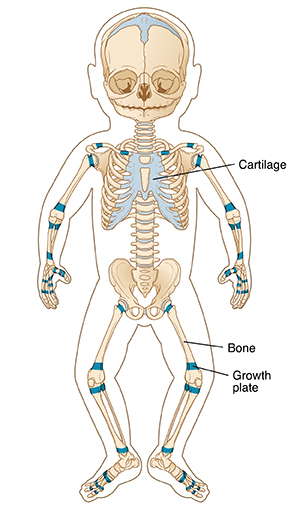
In babies, the bones in the head aren't fused together. This allows the head to be flexible so it can pass through the birth canal during childbirth. The bones in the skull don’t fully fuse until ages 1 to 2.
-
Children have more dense, elastic tissue (called cartilage) in their joints and other bony structures (such as the ribs). This allows the bones to continue to develop and grow as the child grows. This extra cartilage develops into bone over time. By about age
16 , most extra cartilage has matured into bone. -
Children have growth plates in each long bone. A growth plate is an area of soft bone at each end of the long bones. Growth plates allow the bone to grow as the child grows. The growth plates fuse by the time a child is
14 to 18 years old.
Featured in
Online Medical Reviewer: L Renee Watson MSN RN
Online Medical Reviewer: Raymond Turley Jr PA-C
Online Medical Reviewer: Thomas N Joseph MD
Date Last Reviewed: 08/01/2024
© 2000-2025 The StayWell Company, LLC. All rights reserved. This information is not intended as a substitute for professional medical care. Always follow your healthcare professional's instructions.
Personalized Pediatric Care
San Juan Health Partners Pediatrics. Dedicated to caring for your children.
Find a Doctor
Call for an Appointment
Offering personalized care at more than 20 clinics across three cities and two states.
Call NowRelated Articles
Supportive Treatment for a Cleft Lip or Palate
Treatment can help your child develop physically and emotionally. This sheet gives you tips on how to prepare your child for these important treatments.
Flat Head Syndrome (Deformational Plagiocephaly)
Flat head syndrome (deformational plagiocephaly) is when a baby's head develops a lasting flat spot. The flat spot may be either on one side of the head or on the back of the head. This happens when a baby sleeps in the same position most of the time or because of problems with the neck muscles.
Why Well-Child Visits Matter More Than You Might Think
Taking your baby to see a doctor is important when your little one is sick. But going to regular well-child visits can be just as important.
Your Child's Feet
Having strong, healthy feet allows your child to walk, run, and play. Read on to learn what to expect with your baby's and toddler's developing feet.