Problems that affect a woman's fertility can be treated in several ways. Some treatments help sperm or eggs pass through the reproductive tract. Others help an embryo implant in the uterus. Your healthcare provider will talk with you about your options.
We understand gender is a spectrum. We may use gendered terms to talk about anatomy and health risk. Please use this sheet in a way that works best for you and your health care provider as you talk about your care.
Treating the cervix
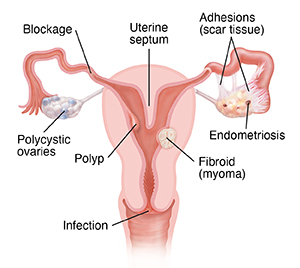
Problems with the cervix may stop sperm from entering the uterus. They include:
-
A lack of cervical mucus. This can slow or block the passage of sperm. This can be treated with assisted reproductive techniques.
-
An infection. This can be treated with antibiotics.
Treating the fallopian tubes
There may be a problem in the fallopian tubes. This can stop sperm from reaching an egg. The treatment depends on the cause. Causes include:
-
A tubal blockage near the uterus. This can be treated by putting a thin tube (catheter) through the blocked tube. Or it can be treated by using assisted reproductive techniques.
-
Scar tissue (adhesions). These can be removed with surgery. Or assisted reproductive techniques may be used.
Improving implantation
A fertilized egg may not implant in the uterus for several reasons. The treatment depends on the cause. Causes include:
-
Problems with the endometrium. These can be treated with hormone therapy.
-
Scar tissue in the uterus. This is treated with surgery.
-
Small growths called fibroids. These are removed with surgery.
-
A uterine septum. This is tissue that divides the uterus into two parts inside. This is treated with surgery.
Treating endometriosis
The endometrium is the lining of the uterus. In some cases, this tissue can grow in other parts of the reproductive tract. It can lead to fertility problems. Laparoscopic surgery is done to remove the tissue.
Reversing tubal ligation
Tubal ligation is a surgery to prevent pregnancy by blocking the fallopian tubes. In some cases, it can be reversed with surgery to reconnect the tubes. But the chances of success are not certain. Talk with your health care provider to learn more.
Online Medical Reviewer: Marianne Fraser MSN RN
Online Medical Reviewer: Sravani Chintapalli
Online Medical Reviewer: Tennille Dozier RN BSN RDMS
Date Last Reviewed: 12/01/2024
© 2000-2025 The StayWell Company, LLC. All rights reserved. This information is not intended as a substitute for professional medical care. Always follow your healthcare professional's instructions.
Compassionate Care for Women
San Juan Health Partners Obstetrics & Gynecology. With two locations serving Four Corners women.
Find a Doctor
Call for an Appointment
Offering personalized care at more than 20 clinics across three cities and two states.
Call NowRelated Articles
Emergency Contraception (EC)
Emergency contraception is used to prevent a pregnancy after a woman has had unprotected sex.
Understanding Fertility Problems: Assisted Reproduction
ART may be needed for certain fertility problems. Or it may be used if other treatments haven’t helped. In most cases, these methods use hormone medicines along with other techniques to increase the chances of success.
Understanding Fertility Problems: Keeping a Positive Attitude
Dealing with fertility problems can be exhausting. But if you feel discouraged or depressed, remember that you’re not alone. Keep sharing your feelings with your partner. Take advantage of help from your provider, family, or support groups.
Understanding Fertility Problems: A Woman’s Evaluation
To help your healthcare provider look for the cause of fertility issues, you will have an evaluation. It will include a medical history, physical exam, and some basic tests. If needed, your healthcare provider may also suggest procedures. These allow them to look at your reproductive organs.