Pregnancy begins when a woman’s egg and a man’s sperm join. This is called conception or fertilization.
The woman’s role in conception
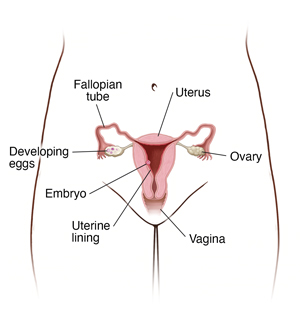
Each month, one of a woman’s ovaries releases a mature egg (ovulation). The egg travels to the fallopian tube. If sperm are present, one of them may join with the egg to form an embryo. The embryo then travels to the uterus. There, it implants in the uterine lining, where it grows to become a baby. If conception doesn’t occur, the egg and the uterine lining are shed during your period (menstruation). A new cycle begins.
The man’s role in conception
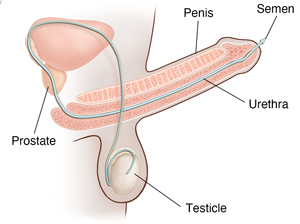
Sperm are made in a man’s testicles. Fluid made by the prostate gland combines with sperm to form semen. During a man’s orgasm, semen flows to the urethra and out of the penis (ejaculation). If the semen was ejaculated in or near a woman’s vagina, sperm may travel into the uterus and the fallopian tubes. There, a sperm may join a mature egg to form an embryo. This results in pregnancy.
Online Medical Reviewer: Donna Freeborn PhD CNM FNP
Online Medical Reviewer: Heather M Trevino BSN RNC
Online Medical Reviewer: Howard Goodman MD
Date Last Reviewed: 04/01/2025
© 2000-2025 The StayWell Company, LLC. All rights reserved. This information is not intended as a substitute for professional medical care. Always follow your healthcare professional's instructions.
Compassionate Care for Women
San Juan Health Partners Obstetrics & Gynecology. With two locations serving Four Corners women.
Find a Doctor
Call for an Appointment
Offering personalized care at more than 20 clinics across three cities and two states.
Call NowRelated Articles
Blood Glucose Screening During Pregnancy
A blood glucose screening tests for gestational diabetes. With this disease, changes in your body during pregnancy cause your blood sugar (glucose) to be too high. This is a serious condition. But it can be controlled with diet and, if needed, medicine.
Discharge Instructions: Flushing Your Total Parenteral Nutrition (TPN) Catheter
When using TPN, it's important to flush your catheter to keep it from clogging. Learn how to flush your TPN catheter between uses.
Discharge Instructions: Administering IV Antibiotics
Your healthcare provider prescribed home IV or intravenous antibiotics for you. You were shown how to give your IV antibiotics in the hospital. This sheet helps you remember the steps when you’re at home.
Hyperemesis Gravidarum
Hyperemesis gravidarum is a severe form of morning sickness that can affect some women during pregnancy. Symptoms include severe nausea and vomiting.