
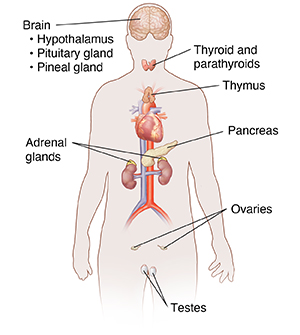
The endocrine system is a complex network of glands and organs. It uses hormones to control and coordinate your body's metabolism, energy level, reproduction, growth and development, and response to injury, stress, and mood. The following are key parts of the endocrine system.
-
Hypothalamus. The hypothalamus is located at the base of the brain. It makes hormones that control hormones released in the pituitary gland. The hypothalamus controls water balance, sleep, temperature, appetite, mood, reproductive behaviors, and blood pressure.
-
Pineal gland. This gland is located in the middle of the brain. It makes the hormone melatonin. This hormone helps your body know when it's time to sleep. This hormone also regulates the timing of other functions throughout the body, such as when puberty starts.
-
Pituitary gland. This gland is located below the brain. It is often as small as a pea. But it controls many functions of the other endocrine glands.
-
Thyroid and parathyroid. These glands are located in front of the neck, below the voice box (larynx). The thyroid plays a key role in the body's metabolism. The parathyroid helps regulate the body's calcium balance and bone strength.
-
Adrenal gland. An adrenal gland is located on top of each kidney. Like many glands, these work together with the hypothalamus and pituitary gland. The adrenal glands make and release corticosteroid hormones and adrenaline (epinephrine). These maintain blood pressure and regulate metabolism.
-
Pancreas. This organ is located across the back of the belly (abdomen), behind the stomach. It plays a role in digestion and hormone production. Hormones made by the pancreas include insulin and glucagon. These regulate blood sugar levels.
-
Ovaries. The ovaries are located on both sides of the uterus, below the opening of the fallopian tubes. The ovaries contain the egg cells needed for reproduction. They also make estrogen and progesterone.
-
Testes. The testes are located in a pouch that hangs suspended outside the male body. The testes make testosterone and sperm.
Online Medical Reviewer: Raymond Kent Turley BSN MSN RN
Online Medical Reviewer: Rita Sather RN
Online Medical Reviewer: Robert Hurd MD
Date Last Reviewed: 02/01/2025
© 2000-2025 The StayWell Company, LLC. All rights reserved. This information is not intended as a substitute for professional medical care. Always follow your healthcare professional's instructions.
Find the right provider to meet your needs
From primary care to specialty services and more.
Find a Doctor
Call for an Appointment
Offering personalized care at more than 20 clinics across three cities and two states.
Call NowRelated Articles
The Pancreas
Detailed anatomical description of human pancreas, including simple definitions and labeled, full-color illustrations.
Hypothyroidism
Hypothyroidism is the most common type of thyroid disorder. It means your thyroid gland is not active enough. This tiny gland is found in your neck. Its job is to make thyroid hormone. If the gland is underactive, it may not make enough thyroid hormone.
Thyroid Cancer: Targeted Therapy
Detailed information on targeted therapy for thyroid tumors.
The Thyroid Gland
Detailed information on the thyroid gland, including anatomy and function.