If you have a tracheostomy tube
Your tracheostomy (trach) tube has been chosen to fit well and work right for you. You’ll learn how to keep it clean and clear. Often, a trach tube is needed for only a short time. Your surgeon will tell you how long to use the tube. If you don’t need a new airway after surgery, the hole in the front of your throat will close on its own after the trach tube has been removed. You will have a dressing over the site while it heals. In some cases, surgery is needed to close the hole.
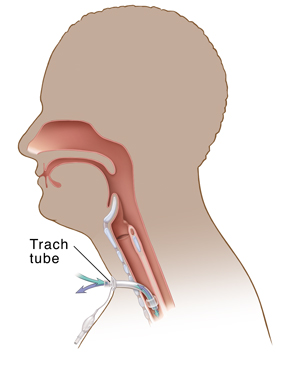
If you have a stoma
If your larynx was removed during surgery, you’ll continue to breathe through the hole in your throat. This hole is called a stoma or permanent tracheostomy. It's important that you and those who care for you know that this is your only airway. In a medical emergency, healthcare providers won't be able to put in a breathing tube through your nose or mouth. You’ll be shown how to care for your stoma. Support groups can help you adjust to having a new airway. And you can return to work, family life, and many of the activities you enjoyed before surgery.
You will need follow-up visits for your tracheostomy and its care.
When to call your healthcare provider
Call your healthcare provider right away if you have any of these problems:
-
A red or painful stoma
-
Small amount of bleeding, that stops promptly, from the tube or stoma
-
Yellow, smelly, bloody, or thick mucus around or inside your stoma
-
Pain while cleaning your airway
-
Persistent cough
Call 911
Call 911 if any of the following occur:
-
Trouble breathing or wheezing
-
Coughing up blood
-
Large amount of bleeding, or persistent bleeding, from the tracheostomy site
-
Swelling around the trach tube or stoma
Online Medical Reviewer: Jessica Gotwals RN BSN MPH
Online Medical Reviewer: Mary Mancini MD
Online Medical Reviewer: Ronald Karlin MD
Date Last Reviewed: 12/01/2022
© 2000-2025 The StayWell Company, LLC. All rights reserved. This information is not intended as a substitute for professional medical care. Always follow your healthcare professional's instructions.
Find the right provider to meet your needs
From primary care to specialty services and more.
Find a Doctor
Call for an Appointment
Offering personalized care at more than 20 clinics across three cities and two states.
Call NowRelated Articles
After a Thoracoscopy
Here is what to expect after a thoracoscopy. Learn about recovering in the hospital and how to care for yourself at home.
Discharge Instructions Needle Biopsy: Lung
You had a procedure called a needle biopsy on a lung. In this procedure, a hollow needle is used to take 1 or more samples of your lung tissue. The tissue is then looked at under a microscope. There are several different types of needle biopsies.
Ventilator-Associated Pneumonia
People on breathing machines, called ventilators, have an increased risk of developing pneumonia. Ventilator-associated pneumonia (VAP) is caused by germs that enter the lungs when a person is on a breathing machine.
BiPap
Some medical problems can make it hard for you to breathe. In these cases, you might benefit from bilevel positive airway pressure. It is commonly known as BiPap or BPap. It is a type of ventilator - a device that helps with breathing.