A respirator is a device to protect you from inhaling dangerous substances, such as chemicals and infectious particles.
These respirators do not supply oxygen from any other source except the working atmosphere. Therefore, they cannot be used in an atmosphere that is oxygen-deficient or immediately dangerous to life or health.
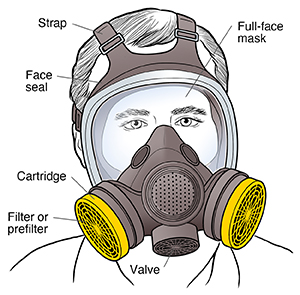
To get the best protection from a respirator, you need to learn about its different parts. When used, maintained, and replaced correctly, the parts of a respirator can lessen your exposure to nearby hazards.
-
Straps hold the mask snugly in place.
-
A face seal keeps contaminants out of the mask.
-
A cartridge is a container with a filter, sorbent, catalyst, or combination of these items that removes specific contaminants from the air passed through the container. It captures certain gases and vapors.
-
A filter or prefilter is a component used in respirators that removes solid or liquid aerosols from the inhaled air. It traps particles.
-
A full-face mask adds eye protection.
-
A valve opens when you exhale and closes when you inhale.
The full facepiece covers roughly from the forehead to below the chin. These types of respirators tend to provide a more reliable face seal. Since these respirators cover the user’s face and eyes, they can also be used to protect against liquid splashes and irritating vapors.
Filtering out the hazards
Cartridges trap gases and vapors. Filters trap particles. All cartridges, filters, and prefilters must be certified by NIOSH (National Institute for Occupational Safety and Health). NIOSH rates filters on a scale of 3 efficiency levels. These are 95%, 99%, and 99.97%. The minimal level of filtration that will be approved by NIOSH is 95%. Within these efficiency levels are 3 filter types. These are N, R, and P. This classification refers to how effective a filter works when exposed to oils:
-
N filters. These are used when there are no oily particles. They are not resistant to oils.
-
R filters. These can be used to protect against oily particles. They are somewhat resistant to oils.
-
P filters. These provide the highest level of safety against all particles. They are strongly resistant to oils.
When to replace filters and cartridges
Follow instructions from your supervisor or the respirator manufacturer to learn when to replace your prefilter, filter, or cartridge.
When cleaning and sanitizing a respirator, follow the manufacturer’s guidelines. should always be followed. Check the manufacturer’s website if guidance is not included with the packaging of the respirator.
Online Medical Reviewer: Horowitz, Diane MD
Online Medical Reviewer: Horowitz, Diane, MD
Date Last Reviewed: 05/01/2024
© 2000-2025 The StayWell Company, LLC. All rights reserved. This information is not intended as a substitute for professional medical care. Always follow your healthcare professional's instructions.
Find the right provider to meet your needs
From primary care to specialty services and more.
Find a Doctor
Call for an Appointment
Offering personalized care at more than 20 clinics across three cities and two states.
Call NowRelated Articles
Road Rash
Road rash is a common term for multiple skin scrapes (abrasions) that occur during a bicycle or motorcycle accident, or even any fall when you slide across a rough surface. It's important that you watch for any new symptoms that might be a sign of hidden injury.
Maintenance-Free Respirators
Maintenance-free respirators are one of the most common types. They are worn to capture particles.
Reducing Risk of Work-related MSDs: Part of Your Health and Safety Program
Reducing job-related injuries is part of every health and safety program. By taking responsibility for your health and well-being, you help prevent future injury and control any present symptoms.
Understanding Bone Bruise (Bone Contusion)
A bone bruise is an injury to a bone that is less severe than a bone fracture. Bone bruises are fairly common. They can happen to people of all ages. Any type of bone in your body can get a bone bruise.