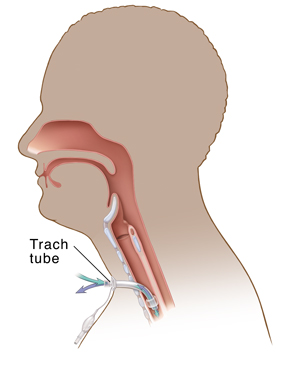
A tracheostomy gives you a new pathway for air to go into and out of your lungs. To create this pathway, you need surgery to make a small opening in your neck. A tracheostomy tube (also called a trach tube) is then placed into this opening. Air then flows more directly in and out of your lungs through the tube.
How to say it
tray-kee-AHS-toh-mee
Reasons for a tracheostomy
Some of the reasons that a tracheostomy may be needed include:
-
Throat swelling that blocks the airway, such as from an allergic reaction
-
Throat damage, such as a burn
-
An object or growth, such as a tumor that blocks the throat or trachea
-
Respiratory failure and the need for extra oxygen, such as with severe emphysema
-
Problems breathing during sleep (sleep apnea)
-
Paralysis of the belly (abdomen), chest, neck, or throat that affects breathing
-
Surgery on the larynx, oral cavity, or throat
-
Cancer in or near the trachea
-
Need for long-term breathing help with a machine (ventilator)
How a tracheostomy works
Surgery is done to make a small opening through the front of your neck into your trachea. This opening is called a stoma. A short tube (trach tube) is placed into the stoma. One end of the trach tube rests outside of your neck. The other end rests inside your trachea. When you breathe in, air flows through the trach tube into your trachea and to the lungs. When you breathe out, air flows back out of the trach tube. Some people need the new airway for only a short time. Others may need it for the rest of their life. Your healthcare provider or surgeon will discuss your needs with you.
Questions and answers
Q: Will I be able to speak with a tracheostomy?
A: It depends. Most tracheostomies can be fitted with a speaking valve. You may also be able to speak by closing off your tracheostomy with your finger briefly at certain times. Electrical devices are available or you can learn esophageal speaking. It will also depend on your ongoing need for a mechanical ventilator, and how intact and functional your vocal cords are.
Q: Will I be able to eat food with a tracheostomy?
A: Yes. Most people can eat, but you may need to take some safety steps. In some cases, you may need to change your diet to softer foods.
Q: How long will it take for my opening to heal once the tracheostomy tube is removed?
A: In most cases, healing only takes a few days. The longer the tube is in place, the longer it takes to heal.
Online Medical Reviewer: Jessica Gotwals RN BSN MPH
Online Medical Reviewer: L Renee Watson MSN RN
Online Medical Reviewer: Mary Mancini MD
Date Last Reviewed: 02/01/2024
© 2000-2025 The StayWell Company, LLC. All rights reserved. This information is not intended as a substitute for professional medical care. Always follow your healthcare professional's instructions.
Find the right provider to meet your needs
From primary care to specialty services and more.
Find a Doctor
Call for an Appointment
Offering personalized care at more than 20 clinics across three cities and two states.
Call NowRelated Articles
Appendectomy
An appendectomy is surgery to remove the appendix when it is infected. This condition is called appendicitis. Appendectomy is a common emergency surgery.
Foot Surgery: Surgical Settings
Your healthcare provider can tell you where your surgery will be done. You will also be told the type of anesthesia you’ll be given during surgery to stay pain-free during the procedure.
Nutrition After Surgery
Some people feel a little nauseated after surgery. This is often due to medicines, dehydration, or simply the stress of surgery. Follow these helpful tips.
Understanding Malignant Hyperthermia
Malignant hyperthermia is a rare reaction to certain medicines used for general anesthesia. The problem is severe and life threatening, but it can be treated.