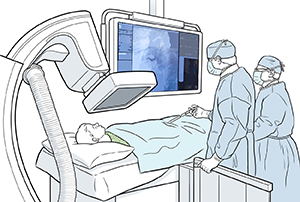
Cardiac catheterization is a procedure done on the heart using a thin, flexible tube (catheter). It’s done by a cardiologist specially trained to treat heart problems using these catheters. The procedure lasts about 2 to 4 hours. It takes place in a catheterization lab. You’ll stay in the waiting room during the procedure.
-
Before the procedure. You’ll be told whether to keep your child from eating or drinking anything for a certain amount of time before the procedure. Follow these instructions carefully.
-
During the procedure. Your child is given medicine (sedative or anesthesia) to help them relax and not feel pain during the procedure. A breathing tube may be placed in your child’s trachea (windpipe) during this time. Special equipment keeps track of your child’s heart rate, blood pressure, and oxygen levels. The catheter is put into an artery in the groin. With the help of live X-rays, the catheter is advanced up through the artery to the aorta where the defect is located. Contrast dye may be injected through the catheter. The dye allows the inside of the aorta to be seen more clearly on X-rays. A balloon at the end of the catheter is used to widen the narrowed area. A wire mesh tube (stent) may also be placed to prevent narrowing from occurring again. This is often done in older children. Once the narrowed area has been widened, the catheter and balloon are removed.
-
After the procedure. Your child is taken to a recovery room. You can be with your child during much of this time. It may take several hours for the medicine to wear off. Pressure is put on the catheter insertion site to limit bleeding. The doctor will tell you how long your child needs to lie down and keep the insertion site still. Your child is cared for and checked on until they can leave the hospital. Your child will likely need to stay in the hospital overnight.
Risks and complications of cardiac catheterization
-
Reaction to contrast
-
Reaction to sedative or anesthesia
-
Pain, swelling, redness, bleeding, or drainage at the catheter insertion site
-
Heart rhythm problem (arrhythmia)
-
Injury to the heart or a blood vessel
-
Some narrowing remains and more surgery may be needed
When to contact the doctor
After the procedure, contact the doctor right away if your child has:
-
Increased redness, draining, swelling, warmth, or bleeding at the incision or insertion site.
-
A fever of 100.4°F (38°C) or higher, or as advised by your child's doctor.
-
Trouble feeding.
-
Tiredness.
-
A cough that won’t go away.
-
Nausea or vomiting that continues.
-
Pain, coldness, numbness, or a bluish color in the leg where the catheter was inserted.
Call 911
Call
-
Shortness of breath or trouble breathing
-
Irregular heartbeat
-
The catheter insertion site swells up very fast
-
Bleeding from the catheter insertion site does not slow down when you press on it firmly
-
Passing out or unresponsiveness
What are the long-term concerns?
-
After repair of COA, most children can be active and participate in sports and other physical activities.
-
Your child will need regular follow-up visits with the cardiologist. The number of visits may decrease as your child grows older. COA may reoccur over time. Your child may need more treatment when they are older.
-
Medicines may be prescribed to treat problems, such as high blood pressure. This is common in children with a history of COA. It often affects older children.
-
For a while after the procedure, your child may need to take antibiotics before having any surgery or dental work done. This is to prevent infection of the inside lining of the heart or valves. This infection is called infective endocarditis. Antibiotics should be taken as directed by the cardiologist.
Online Medical Reviewer: Ayden, Scott, MD
Online Medical Reviewer: Bass, Pat F. III, MD, MPH
Date Last Reviewed: 05/01/2025
© 2000-2025 The StayWell Company, LLC. All rights reserved. This information is not intended as a substitute for professional medical care. Always follow your healthcare professional's instructions.
Personalized Pediatric Care
San Juan Health Partners Pediatrics. Dedicated to caring for your children.
Find a Doctor
Call for an Appointment
Offering personalized care at more than 20 clinics across three cities and two states.
Call NowRelated Articles
Surgery for Total Anomalous Pulmonary Venous Return for Children
Total anomalous pulmonary venous return (TAPVR) is a condition where the vessels from the lungs take an abnormal path back to the heart. TAPVR surgery is open heart surgery to fix this problem.
Ventricular Septal Defect Surgery for Children
Ventricular septal defect surgery is a type of heart surgery. It's done to fix a hole between the left and right ventricles of the heart. Read on for details.
The Clinical Cardiac Electrophysiologist
A clinical cardiac electrophysiologist, or cardiac EP, is a health care provider who treats rhythm problems of the heart. Learn more about their medical training, and the tests and procedures that they do.
Double Outlet Right Ventricle Surgery for Children
Double outlet right ventricle surgery is a procedure that fixes a type of heart malformation called double outlet right ventricle (DORV).