Endovenous laser treatment (EVLT) is a procedure that uses laser heat to treat varicose veins.
Varicose veins are swollen and enlarged veins. They occur most often in the legs. Varicose veins can develop when valves in your veins become damaged. This causes problems with blood flow. Over time, too much blood collects in the veins. The veins may bulge, twist, and stand out under your skin. They can also cause symptoms such as aching, cramping, or swelling in your legs.
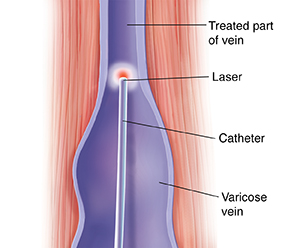
During EVLT, heat created from a laser is sent into the vein through a thin, flexible tube (catheter). This closes off blood flow in the main problem vein.
Getting ready for your treatment
Follow any instructions from your doctor.
Tell your doctor if you:
-
Are pregnant or think you could be.
-
Are breastfeeding.
-
Smoke or use alcohol on a regular basis.
-
Have other health problems, such as diabetes or kidney problems.
Tell your doctor about any medicines you are taking. You may need to stop taking all or some of these before the procedure. This includes:
-
Medicines that can thin your blood or prevent clotting.
-
All prescription medicines.
-
Over-the-counter medicines such as aspirin or ibuprofen.
-
Street drugs.
-
Herbs, vitamins, and other supplements,
Follow any directions you’re given for not eating or drinking before the treatment.
The day of your treatment
The treatment takes
-
You’ll lie down on a hospital bed.
-
An imaging method, such as ultrasound, is used to guide the procedure.
-
The leg to be treated is injected with numbing medicine.
-
After your leg is numb, a needle makes a small hole (puncture) in the vein to be treated.
-
The catheter containing the laser heat source is inserted into your vein.
-
More numbing medicine may be injected around the vein.
-
After the catheter is in the right position, it's then slowly drawn backward. As the catheter sends out heat, the vein is closed off.
-
In some cases, other side branch varicose veins may be removed or tied off through several small cuts.
-
When the treatment is done, the catheter is removed. Pressure is applied to the site to stop any bleeding. An elastic compression stocking or a bandage may then be put on your leg.
Recovering at home
After you are back home, follow all the instructions you’ve been given. Be sure to:
-
Take all medicines as directed.
-
Care for the catheter site as directed.
-
Check for signs of infection at the catheter site (see below).
-
Wear elastic stockings or bandages as directed.
-
Keep your legs raised (elevated) as directed.
-
Walk a few times a day.
-
Don't do heavy exercise, lift, or stand for long periods as advised.
-
Don't travel by air.
-
Don't sit in hot baths, saunas, or whirlpools.
Contact your doctor
Contact your doctor if you have:
-
A fever of
100.4 ° F (38 ° C) or higher, or as directed by your doctor. -
Chest pain or trouble breathing.
-
Signs of infection at the catheter site. These include greater redness or swelling, warmth, increasing pain, bleeding, or bad-smelling discharge.
-
Severe numbness or tingling in the treated leg
-
Severe pain or swelling in the treated leg
Follow-up
You’ll have a follow-up visit with your doctor within a week. An ultrasound will likely be done to check for problems such as blood clots. Your doctor will discuss more treatments with you, if needed.
Risk and possible complications
These include:
-
Bleeding.
-
Infection.
-
Blood clots.
-
Damage to the nerves in the treated area.
-
Irritation or burning of the skin over the treated vein.
-
Treatment doesn't improve the look or the symptoms of the problem veins.
-
Risks of any medicines used during the treatment.
Online Medical Reviewer: Anne Fetterman RN BSN
Online Medical Reviewer: Deepak Sudheendra MD
Online Medical Reviewer: Raymond Kent Turley BSN MSN RN
Date Last Reviewed: 05/01/2025
© 2000-2025 The StayWell Company, LLC. All rights reserved. This information is not intended as a substitute for professional medical care. Always follow your healthcare professional's instructions.
Find the right provider to meet your needs
From primary care to specialty services and more.
Find a Doctor
Call for an Appointment
Offering personalized care at more than 20 clinics across three cities and two states.
Call NowRelated Articles
Peripheral Angioplasty
Peripheral angioplasty is a procedure that helps open blockages in peripheral arteries. These vessels carry blood to your lower body, legs, and arms.
Preparing for Carotid Artery Stenting
Carotid artery stenting can help reduce the chance that you will have a stroke. Be sure to follow the directions below and any other directions your healthcare provider gives you.
Understanding Surgical Thrombectomy
Surgical thrombectomy is surgery to remove a blood clot from 1 of your blood vessels. The blood clot may be in an artery or vein in your arm, leg, or another part of your body. It may block the flow of blood to your tissues or organs.
Percutaneous Transcatheter Treatment of Deep Vein Thrombosis (DVT)
Percutaneous transcatheter treatment is one type of therapy for deep venous thrombosis (DVT). DVT is a blood clot that forms in a large vein deep in the body. It happens most often in a leg. The procedure uses a long thin tube to help remove the blood clot.